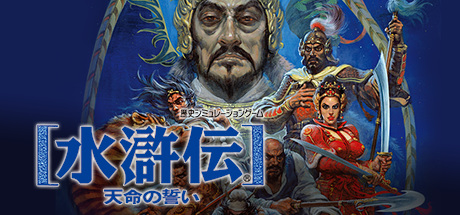
*Bandit Kings of Ancient China*, developed and published by KOEI TECMO GAMES CO., LTD., is a classic strategy simulation that reflects the company’s early ambition to merge historical storytelling with deep, system-driven gameplay. Drawing inspiration from the Chinese literary epic *Water Margin*, the game places players in the role of a rebel leader rising against a corrupt regime during the Song Dynasty. Rather than presenting a straightforward conquest narrative, it frames the experience around the complexities of rebellion—building alliances, managing people, and sustaining a fragile movement in the face of overwhelming authority. Even decades after its original release, it stands out for how seriously it treats its subject matter.
At its core, the game is a hybrid of grand strategy and role-playing elements, with a strong emphasis on character management. Players are not simply commanding armies; they are leading a group of individuals, each with distinct attributes, skills, and personalities. Recruiting capable officers is essential, and their effectiveness depends not only on raw stats but also on how well they are managed. Loyalty becomes a critical factor, as dissatisfied subordinates can weaken your position or even abandon you. This focus on human dynamics gives the game a more personal dimension, where success is tied as much to relationships as it is to military strength.
The strategic layer revolves around governing territories, balancing resources, and expanding influence across a divided map. Each region under your control requires careful attention—taxation must be handled responsibly, troop morale must be maintained, and internal stability must be preserved. Ignoring these responsibilities can lead to unrest or loss of control, reinforcing the idea that leadership is a continuous balancing act. Time progresses through a structured calendar, and every decision carries weight, pushing players to think several steps ahead rather than reacting impulsively.
Combat, when it occurs, takes place on grid-based battlefields that emphasize positioning and tactical awareness. While the mechanics are relatively simple compared to modern strategy games, they still offer meaningful choices. Different unit types and attack methods create opportunities for strategic planning, and battles often hinge on how well you utilize terrain and coordinate your forces. Captured enemies introduce additional decisions—whether to recruit them, remove them, or use them to strengthen your cause—further tying combat outcomes back into the broader management systems.
What defines *Bandit Kings of Ancient China* most strongly is its depth, but that depth comes at the cost of accessibility. The game offers minimal guidance, expecting players to learn its systems through experimentation. Its interface is dated, with text-heavy menus that can feel unintuitive, and its pacing is deliberately slow, prioritizing long-term planning over immediate results. For modern players, these elements can make the experience feel daunting, especially in the early hours when the mechanics are not yet fully understood.
Despite these barriers, there is a remarkable sense of immersion in how the game simulates the rise of a rebel faction. It captures the uncertainty and complexity of leadership, where every gain must be carefully maintained and every decision can have far-reaching consequences. The open-ended nature of the gameplay allows for different approaches, giving players the freedom to shape their own path rather than follow a rigid script. This flexibility, combined with its strong thematic foundation, gives the game a lasting appeal for those willing to engage with its systems.
Ultimately, *Bandit Kings of Ancient China* is a demanding but rewarding experience that showcases the early foundations of Koei’s strategy design. It may feel archaic in presentation and pacing, but beneath those limitations lies a sophisticated simulation that remains compelling in its own right. For players interested in deep, character-driven strategy games or the history of the genre, it offers a rich and thoughtful journey that stands the test of time.
Rating: 7/10