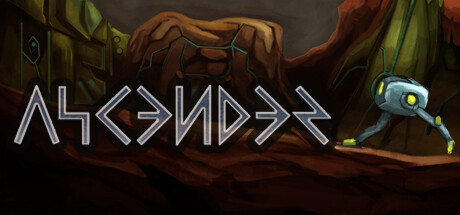
Ascender is a 2D explorative puzzle metroidvania. The game is set in the open world of GOA's districts, and the player will face many unique puzzles to solve. Warning!! This game will truly challenge your puzzle and platforming skill :D
Modeled estimate, not a reported figure. How we estimate →
Media

About


Stats
All-time low is the lowest price we've recorded for this game since we started tracking it.
Languages: English
Engagement
Hours played at review time, across 24 reviews with recorded playtime.
Reviews
It's a fun 2D sidescreen game, you are a robot and you start doing tasks that they give you On your road you figure out controls wich you know of you gonna need them in the far future in the game This world of "goa", have a nice art-like backgrounds It's a good game https://www.youtube.com/watch?v=4QhXWreBYEM
Ascender is a 2D platformer in which you control a small robot tasked with finding components to bring back to your maker. Naturally this means a lot of platforming your way around town running errands for various locals. You pick up a double jump and grappling hook ability early in the game, allowing you jump higher, swing from hooks and pull boxes around to press buttons and build steps, something we've all come to expect from a modern platform game. In the beginning of the game you only have space for one of those abilities at a time and it suggests you will have to choose which abilities you need. In practice once you have passed the beginning you will quickly pick enough upgrades to use these and other abilities together. I thought it was a potentially interesting mechanic that was never really used. It is possible this matters more later in the game. You can also have a speed upgrade which you will need, you are a little on the slow side until then. A tracking device that beeps when you are near something collectable. An ability that allows you to see things that you couldn't before. Presumably there is at least one other ability, but I didn't get far enough to find that. The various locations are of a decent size and are different enough that you do feel you have gone to another part of the city and consistent enough to know you haven't gone too far. You do have a map of the location you are in but not one of the wider city. It's big enough to forget the way, but not big enough to get properly lost. The quest menu usually shows you where to go but not necessarily the best way to get there. You are free to wander around looking for things to collect and talk to people, they all seem to have something unique to say, if not always interesting, some will give you quests which you can complete for some sort of reward. Mostly these are collecting or delivering something at a location that isn't always easy to get to, with some fairly easy puzzle solving along the way. Progressing in some quests may open up other areas or other quests or give you some upgrade or reward that makes another quest easier but other than that you are free to do them in any order. I do not know if any of them are actually optional. There is a day/night cycle with the background and lighting (with an indicator in the top left), but this didn't relate to one quest being blocked until tomorrow (in the hospital), tomorrow must have been triggered by some other quest, although I'm not sure which. On the subject of lighting, there is also occasional rain and an awful lightning effect that makes the background white and the everything else black. Only in computer games does lightning make things darker. Up to about 60% or so completion I'd say it was a nice game. After that (specifically [spoiler]Aldrin being chased and the creature under the water tanks[/spoiler]) the precise timing and jumping aspect increases in difficulty. Which depending on your view is either a good challenge in what has been a fairly relaxed game to this point, or an unwanted if not entirely unexpected increase in frustration. I don't have the patience to continue for now, that probably tells you more about me than the game. I'd say the game (so far) was good enough that it deserves a look from someone who likes and is good at platform games. I didn't encounter any bugs in the Linux version. Play with a controller, there is no proper key mapping, only a set of presets for flat qwerty people with weird hands. The English text could benefit from a proofread, the grammar is a little strange in places but it is fully understandable and should not distract from the game. (Having said that this review will now be full of mistakes.)
Just purchased this game when its released and I'm glad this game is from Indonesia. Just played 30 min but I'll play it again later. I really love the background music and the story but I hope the devs should be improving the controls better or the character physics when the character walking on the tilt grounds in the future patch update.
I am 32 years old. My ex-wife and I have a daughter together, and we adopted our son together. Both are now 4 years old. When we were going through our separation, I felt lost and unhappy. I was self-destructive. One day, I was so angry with everything spiraling out of control that I punched a concrete wall in a moment of overwhelming emotion. This resulted in breaking my fifth metacarpal in my right hand—the hand I worked with, played games with, and used to carry my children to bed—the hand I desperately needed to ensure I could continue providing. Upon learning the severity of the self-inflicted damage, I became almost suicidal. Keep in mind that just a few months before this, I was the happiest man, with no history of depression or anxiety. I had never experienced anger outbursts, nor was I the type to break down and cry, but I was in a tough situation that truly prevented me from seeing the light on the other side. With nothing better to do, I looked for a game I could play WITH ONE HAND while recovering. Somehow, I stumbled upon this game and read some of the comments. I decided it was worth a try... I must admit I didn't beat the game, nor did I play as much as some of you. In fact, I may have played this game for only a day or two. That being said, after doing so, I had a new joy and hope for life. I managed to leave behind the pain and suffering that had been thrust upon me. I could experience the joy and happineass of other people. I relaxed for 5 ♥♥♥♥ minutes listening to this music, long enough to realize that I would be okay. After realizing this, I turned off the game and went back to work. My hand hurt a lot, but I was motivated. I stopped feeling so sorry for myself and became the father I needed to be at that moment, not the weak boy I was behaving like. Today, I am close friends with the mother of my children. We don't fight, argue, or say hurtful things to each other. We are parents and friends. Now I have 3 children. My third child is, wait, ALSO 4 YEARS OLD. The woman I am with was going through a very similar situation at the time of my separation, and we just unexpectedly stumbled into each other's lives. We have been dating for a year and are very happy together. Moral of the story: you never know what life has in store for you, and if I had given up when all odds were against me, I wouldn't be where I am today. This silly little game helped me realize that. Thank you.
[h1] Smells like rotten socks to me... [/h1]
无法正常跳成就,想要通关耗时极长。 主角是个发明来帮收集钛条的短腿机器人,终极目标是收集40钛条。在教授交代此目标前,有一连串的前置任务(5小时):拿ID,市场找人,修电梯。被交代40钛条的目标后,任务就无主次之分了,每完成一个奖励1~2条。 主角靠装备符石解锁新的动作。总共9种符石,怀疑想要通关可能需要全部收集。 在装备了2段跳、钩爪、爆破钩爪(?)后,基本上没什么路是主角不能走的了。 这游戏的所有追逐战都很难。我都过不了,不清楚为了最终通关是否一定得过。 ○农场地图有个长腿机器人跟主角赛跑,步速跟主角一样,也就是中途不能有任何失误。此外,它能跳上主角不能上的桥,而主角必须用钩爪钩住两个箱子荡过去。太难了,不打算比赢他了。后期有人提到这种机器人有加速的符石,猜测赢了他可能可以获得? ○农场洞穴娃娃鱼会吐泡泡打飞主角,平台小,地面水碰到即死。无中途存档。此处收集了版画碎片才会触发,收版画碎片(11个)任务不清楚是否主线。 ○我卡关在:黑白地图的跟大小熊猫赛跑救小孩。游玩时长8小时,钛条收集了12/40。卡关原因是追逐战中途无自动存档,主角跑的很慢,通关此关中途不能浪费任何一秒。练了1小时,终于能跑到了二楼快终点处(前面解决了7个障碍),之后需要连续勾住并放下三块石头让它们不砸到小孩。石头间距极小,小孩跑得飞快,根本来不及换石头。 P.S. 游戏中出现的几种动物超有趣的:“猫”头鹰,猪皮牛,龟壳兔,大小熊猫(长小熊猫尾巴+耳朵的熊猫)。
Great art and looks like they put a lot of effort in making this game But the core gameplay is kinda confusing, it's all great but I don't feel like playing for long
是一个横板2D游戏 我卡关了 质量还可以。
Ascender, developed and published by GameChanger Studio, is a 2D puzzle-platformer that blends metroidvania exploration with a focus on experimentation and thoughtful progression. It presents itself as a journey through a layered, mysterious world, where movement, problem-solving, and gradual discovery are tightly interwoven. While it doesn’t aim for massive scale, it leans into its systems and atmosphere to create an experience that feels deliberate and quietly ambitious. The structure of the game follows a familiar metroidvania framework, where progress is tied to unlocking new abilities that expand how you interact with the environment. You navigate interconnected areas, often encountering paths or obstacles that can only be overcome later once you’ve gained the appropriate tools. This encourages backtracking in a meaningful way, as returning to earlier sections with new abilities reveals hidden routes and previously inaccessible secrets. Exploration becomes more than just movement—it becomes a process of reinterpreting the world as your capabilities evolve. What sets Ascender apart is its approach to abilities and progression. Instead of simply acquiring fixed powers, the game introduces a system that allows players to experiment with different configurations. This adds a layer of customization, where solving puzzles often involves not just having the right ability, but using it in the right combination. The result is a gameplay loop that rewards creativity and adaptation, with many challenges offering multiple possible solutions. When the system works well, it creates satisfying moments of realization, where understanding the mechanics becomes just as important as executing them. The platforming itself is precise and controlled, requiring careful timing and positioning. Movement feels deliberate, which complements the puzzle-heavy design, but it also means that mistakes are often the result of small miscalculations. The difficulty leans toward the challenging side, particularly in sections that combine platforming with puzzle elements. While this can be rewarding for players who enjoy mastering mechanics through repetition, it may feel demanding for those looking for a more relaxed experience. Narrative elements are woven subtly into the experience, focusing on themes of identity, purpose, and connection. The story is not delivered through constant dialogue or exposition, but instead unfolds gradually through exploration and small interactions. This understated approach allows players to interpret the world and its characters in their own way, though it also means that the narrative may feel distant or incomplete for those expecting a more direct storytelling style. Visually, Ascender adopts a colorful and stylized aesthetic that contrasts with its more introspective tone. The environments are varied enough to keep exploration engaging, with each area offering distinct visual cues that help guide the player. The design emphasizes clarity, ensuring that important elements stand out without overwhelming the screen. The overall presentation supports the gameplay effectively, even if it does not aim for high levels of detail or technical complexity. Despite its strengths, the game’s systems are not always fully realized. While the ability customization introduces interesting ideas, some mechanics feel underdeveloped or underutilized, leaving the impression that there was potential for greater depth. The pacing can also be uneven, with certain sections feeling slower or less engaging than others. Additionally, while the controls are generally reliable, there are moments where they feel slightly stiff, particularly in more demanding sequences. The scope of the game is relatively modest, which works both in its favor and against it. On one hand, it keeps the experience focused and prevents it from becoming overwhelming. On the other, it limits the sense of scale and variety, especially when compared to larger titles in the same genre. The world is cohesive, but it does not always feel as expansive or interconnected as it could be. In the end, Ascender is a thoughtful and engaging puzzle-platformer that succeeds through its emphasis on experimentation and exploration. It may not fully capitalize on all of its ideas, but it offers a solid and rewarding experience for players who enjoy combining platforming with problem-solving. Its strength lies in how it encourages players to think about their tools and approach challenges creatively, making each moment of progress feel earned. Rating: 7/10
Recommended for game farming
Related
Related
Trends
Modeled estimate over time, reconstructed from Steam's monthly review histogram.
Momentum
Pace estimated from the game's recent review growth (our daily snapshots) at its own sales-per-review ratio — a momentum signal, not booked sales.
Audience
Estimated from the language of this game's reviews — a proxy for where players are, not official Steam demographics.
Related
| Catboy Aim Trainer | $3.6K | 177 | 93% | $0.99 |
| Jump Fucker | $3.6K | 52 | 58% | $4.99 |
| Kittenwood Cats - A Hidden Object Game | $3.6K | 214 | 98% | $1.29 |
| Simple FPS Aim Trainer | $3.6K | 77 | 92% | $1.99 |
| Succubus RoomMate | $3.6K | 87 | 83% | $2.99 |
| Grandma's House: College Days | $3.6K | 87 | 84% | $2.99 |