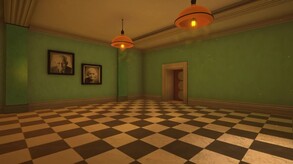
Andarin Weppes is a first person puzzle experience of a man with ever advancing dementia...
Modeled estimate, not a reported figure. How we estimate →
Media

About
Step into the tangled mind of a dementia patient as he visits the house of his late grandpa, who also suffered from the ethereal embrace of dementia. Witness your perception warp, gravity surrender its grasp and the very essence of space and time tumble into a puzzling dance as your advancing dementia twists your reality into the unfamiliar.
A Surreal Dwelling: Explore a once-familiar house now shrouded in the mystique of dementia. Traverse its non-Euclidean environments, where up and down lose meaning, and rooms meld in perplexing arrangements.
Unravel Puzzles: Engage your mind in solving intricate puzzles scattered throughout the enigmatic abode. Each riddle holds a piece of the profound story that connects memories, dreams, and reality.
Journey Through Memory: Witness the convergence of memories and delusions as you venture deeper into the shifting chambers of the mind. Experience the blurred boundaries between lucidity and illusion.
Ambiguous Reality: Embrace the uncertainty. Prepare to question what is real and what is not, as the lines between reality blur.
Discover the Secrets Hidden Inside the Books: Familiarize yourself with the unfamiliar as you decipher the cryptic secrets entwined within the 4 books in the mind-bending architecture of the house. With the books in your hand, make use of their capabilities to fight against your affliction as you wander the house.
Rewind: Fear no more from mistakes of the past.
Prepare your mind for a symphony of illusions and truths, and immerse yourself in a journey where the journey and the destination are an enigma. Dare to tread the paths that defy reason and embrace the boundless realm of a dementia inflicted mind. Step forth into the mysteries of Andarin Weppes and uncover the surreal truth that awaits within.
Stats
All-time low is the lowest price we've recorded for this game since we started tracking it.
Languages: English, Turkish, French, Italian, German, Spanish - Spain, Japanese, Korean, Polish, Portuguese - Brazil, Russian, Simplified Chinese
Engagement
Reviews
Themes across 40 recent reviews and how positive each mention is. A keyword signal, not full sentiment analysis.
Reviews
I respect the efforts of a single dev and the price point is quite reasonable, but ultimately, the experience just doesn't make a lasting impact. The story is almost non-existent outside of some extremely basic subliminal aspects that are not really expanded on in any meaningful or emotional way. It's too much of a blank slate given the devastating topic. Pros: - Price is very fair for ~20 levels and 1.5 hour playtime. - The initial "oh, weird!" and the non-euclidean geometry fit nicely in the theme of dementia. - A few puzzles had some good "a-ha!" moments. - Music/vibes are OK, passable. Cons: - Almost every single mechanic starts too easy, barely starts to get interesting, and is immediately discarded in lieu of new mechanics. Most aren't reused meaningfully. - The "story" is such a miss, for me. We have a post-it note, a picture, and some shifting geometry/objects...and that is literally it. I guess technically you can count the level names as... lore? It's just way, way, way too little for such a brutal and deep topic. - The marketing, in my opinion, is borderline deceptive in how little it represents the actual gameplay and narrative in the (very short) experience. Examples: - "Each riddle holds a piece of the profound story"...what riddles? What story? What is this supposed to be referencing? - "Witness the convergence of memories and delusions"...what memories? We never see any element of this person's life outside of a chair, a clock, and a fridge. How are those memories, or emotional in any way? - "as you decipher the cryptic secrets entwined within the 4 books"...what ♥♥♥♥♥♥♥ secrets? I got 100% of the achievements and was left with zero story, zero secrets. This is just false advertising.
Related
Related
Trends
Concurrent players on Steam, sampled daily since tracking started.
Hours played at review time, across 40 reviews with recorded playtime.
positive critical· bar length = how often the theme comes up
A good puzzle game. Dementia is portrayed very well in this game. Witnessing the changes over time is effectively conveyed to the player, and I must say I was impressed. The puzzles are well-designed and fun. I struggled with a few parts, but I completed the game. I especially liked the ending and highly recommend it to everyone. Also, the teddy bear is very cute :)
Full Walkthrough: https://www.youtube.com/watch?v=tQPW9qMdiFM ★★★★☆ Gameplay: Decent Graphics: Good Music: Decent PC Requirements: Potato Game Time: 50 min - 1.5 hrs
ボリュームとしては1~2時間で終わるステージクリア型パズルゲーム。パズルが得意な人なら数十分でクリアできる人もいるかもしれません。 「進行性の認知症を患う男性の一人称パズル体験」とありますが、ストーリーが詳細に明示されるわけではなく、プレイヤーに解釈をゆだねられています。各ステージの名称や、本作で特に印象的にフィーチャーされている柱時計の文字盤の状態によって症状の進行が匂わされているものだと思われます。 [h3] おすすめポイント [/h3] ・プレイを妨げるような存在(敵など)は出てこず時間制限もないので落ち着いて遊ぶことができます。ステージのリスタートとは別に「巻き戻し」という機能があり、その名の通り時間を巻き戻してくれるのですが、回数制限が無く、遡る時間も任意なので、プレイングをかなり快適にしてくれています。 ・翻訳が少し拙くやや不自然な日本文になっていますが、逆にこのゲームのコンセプトとかみ合っている気がして個人的には好きです。 ・不安定な雰囲気のBGMも世界観と合致しており、没入感を高めてくれます。BGM音量・効果音量ともにオプションで調整あり。 [h3] 良くないポイント [/h3] ・一人称視点なのに加え、上下左右が移り変わるステージを見回しながら歩き回ることになるため、一般的なパズルゲームより酔いやすい作りになっていると思いますのでそこはご注意ください。
Joe Biden simulator
Amazing puzzle game! :)
Interesting mechanic and stages that become more and more unusual. The story follows a man with dementia. His situation worsens one day when he wakes up and discovers that his bed has vanished. When he eventually finds it on the opposite side of the house, he wakes up to find that everything has changed again. The game's mechanics are interesting because you must first figure out how everything works. Every time you wake up, the house and rooms become more strange and out of place. You might notice holes in rooms, doors that loop, or realize you're walking on a ceiling. The house contains only a few rooms and a limited amount of assets. There are a few bookcases, chairs, and a refrigerator with a note that constantly reminds you to take your pills. Puzzles revolve around books. Their main purpose is that they unlock doors when you place them on a book holder. Regardless of its type, any book can open any door. What's more intriguing about books is that they come with special characteristics. There's one that allows you to jump and another that lets you fly. The challenge comes from the fact that you can only carry one book. This means you will have to run back and forth while swapping books on book holders and overcoming obstacles. The only thing that could stop this is foggy walls that rip a book into pieces. Fortunately, you have a rewind button to keep you from becoming caught in unsolvable circumstances. Gravity also plays a part. Because you can walk through doorways that allow you to walk on both the floor and the wall in the same area, which also changes gravity, a dropped book may fly in any direction. Fortunately, you have a compass that points to the "ground". Dropping books is an important element of the solution since a book holder pulls the book towards it as it gets close. The game has around 20 stages. You can return to any stage from the main menu, but there’s no reason to do so because there are no collectibles. Despite the early access tag, this feels like a complete game.
очень атмосферная и потрясная игра. играть исключительно в наушниках
Andarin Weppes is an unsettling and atmospheric descent into a collapsing mind, framed through the structure of a first-person puzzle adventure. Developed by Mötiv and published by Next in Game, it places you inside the childhood home of the protagonist’s late grandfather—a house once filled with routine and memory that now bends, twists, and reshapes itself in ways that defy logic. The game’s central premise revolves around the deterioration of mental stability, using disorientation not simply as a narrative device but as the fundamental architecture of its world. Every room you enter feels familiar and alien at the same time, and every step forward deepens the tension between memory and illusion. The house itself is the game’s most powerful storytelling tool. Early on, navigation seems straightforward, but cracks in reality begin to appear: floors tilt at impossible angles, hallways loop back into themselves, and doors lead to locations that couldn’t spatially exist. These distortions intensify as the experience progresses, making movement a puzzle in its own right. Rather than giving you traditional, item-heavy puzzle chains, the game forces you to think in terms of shifting geometry—how walls reconfigure, how gravity changes, how a room might behave when viewed from another angle. This creates a distinctive form of environmental storytelling where the instability of the setting mirrors the protagonist’s unraveling mental state. The player becomes both investigator and witness to the fractures in the world, attempting to piece together meaning from spaces that refuse to hold their shape. More conventional puzzles exist, but they too are filtered through the lens of instability. Symbolic locks, coded books, and fragmented clues offer brief footholds of logic, but they rarely function in the expected way. A solution that seems clear one moment may dissolve when a room suddenly warps, or a familiar object may appear in multiple places simultaneously. This unpredictability pushes players to observe carefully and question assumptions, rewarding those who are willing to slow down and adapt to the game’s dreamlike logic. At its best, this approach generates moments of revelation where the shifting mechanics, fractured memories, and environmental clues align in ways that feel both unsettling and resonant. The game’s aesthetic direction amplifies its psychological themes. Visuals rely on muted, desaturated tones that lend the environment a somber, dreamlike quality, while sharp lighting contrasts highlight areas where reality feels thin or unstable. Sound design plays a crucial role as well: distant murmurs, creaking timbers, and subtle tonal shifts create an atmosphere of constant tension. Nothing jumps out at you, yet everything feels just slightly wrong, as if the house itself is aware of your movements. The lack of traditional horror elements—no monsters, no chase sequences, no sudden shocks—allows the experience to burrow deeper into psychological discomfort. It evokes dread not by threatening harm, but by eroding certainty. This commitment to disorientation, however, comes with drawbacks. The game demands patience, and those who rely on clear direction or structured puzzle-solving may find themselves frustrated by the game’s refusal to behave predictably. Some sequences rely heavily on experimentation rather than deduction, and the absence of traditional guidance can lead to moments where progress feels stalled by ambiguity rather than challenge. Controls can become unwieldy when gravity shifts or when rooms rotate unexpectedly, and this may break immersion for players who prefer cleaner mechanical execution. And because the narrative is delivered indirectly—through environmental shifts, symbolic moments, and fragmented memories—its emotional impact depends heavily on the player’s willingness to engage with metaphor. Despite these challenges, Andarin Weppes stands out as a bold, emotionally driven experiment. It approaches the subject of cognitive decline with sensitivity, using its mechanical distortions not merely as tricks, but as reflections of a deteriorating inner world. It asks players to confront discomfort, uncertainty, and confusion—experiences that echo the themes at the heart of the story. For those who gravitate toward atmospheric, introspective games that blur the line between reality and nightmare, it offers a journey that lingers long after the final scene fades. It is not a game that seeks to be reassuring or easily understood, but one that invites contemplation through its fractured spaces and the memories hidden within them. Rating: 7/10

Short but good little puzzle game. It twisted my mind.
Audience
Estimated from the language of this game's reviews — a proxy for where players are, not official Steam demographics.
Related
| Egg Chicken Farm | $2.7K | 53 | 98% | $2.99 |
| Backrooms Cats and Lava | $2.7K | 117 | 77% | $1.49 |
| Tile Tale | $2.7K | 50 | 74% | $2.49 |
| Space Elite Force II | $2.7K | 108 | 88% | $1.49 |
| Desktop Tree | $2.7K | 96 | 95% | $0.99 |
| Word Puzzle Master | $2.7K | 94 | 81% | $1.66 |