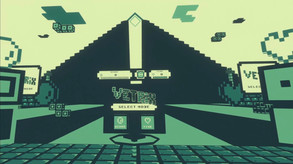
This ain't your Grandma's Tetris! Vetrix is a puzzle game inspired by Tetris, but with its own original mechanics built for virtual reality.
Modeled estimate, not a reported figure. How we estimate →
Media

About
Genres
Stats
All-time low is the lowest price we've recorded for this game since we started tracking it.
Languages: English, French, Italian, German, Spanish - Spain, Japanese, Korean, Simplified Chinese
Engagement
Reviews
Themes across 40 recent reviews and how positive each mention is. A keyword signal, not full sentiment analysis.
Reviews
This would've worked better if the developer just made traditional Tetris in VR instead of trying to reinvent the wheel. In order to clear lines, you have to complete the line in 3D space, both in front and back of the playing field. This not only slows down the game but makes placing the new block, a T block with one side rotated inward (making it 3D), especially frustrating. The developer seems to have realized this by including another new block, a single square to plug holes, but it's so rare that they're almost never useful. Other problems over vanilla Tetris include a lack of upcoming block preview, no increase in speed because of no falling blocks, and broken balance because you can place blocks anywhere. There's also no fail state outside of running out of time in Score Mode... You're expected to just realize the game is over when you can't place more blocks and hit the quit button. I feel bad for putting a red thumb on what was probably someone's first solo project but they're still charging money for this. With how many variations and spin-offs of Tetris that have been released over the years, there's no reason to buy this. It's not even fun to play seated because of the range of motion required to place pieces. You're better off just playing vanilla Tetris for free on countless websites in your browser.
Related
Related
Trends
Modeled estimate over time, reconstructed from Steam's monthly review histogram.
Hours played at review time, across 40 reviews with recorded playtime.
positive critical· bar length = how often the theme comes up
I'm very pleasently surprised. The game does not just try to cash in on the retro-feel but the gameplay itself is quite intriguing and addictive and uses the the additional dimension very well to get a fun new concept out of the silly old blocks while still feeling familiar. (I admit: It feels VERY satisfying to be able to not just turn the L-Blocks and S-Blocks around one axis but two and therefore essentially flip them, which was not possible in 2D ;) ) There are certainly different ways to create a VR-offspring of Tetris. This is a very well thought out one with a quite polished concept that seems hard to improve upon.
Vetrix, developed and published by Vagabond, is a virtual reality puzzle experience that reimagines the classic block-stacking formula through a fully three-dimensional lens. Rather than simply adapting a familiar falling-block concept into VR as a novelty, the game reconstructs the core mechanics around spatial freedom, removing gravity constraints and encouraging players to think in all directions at once. The result is a deceptively simple yet mentally engaging title that demonstrates how VR can meaningfully transform traditional arcade ideas. At its foundation, Vetrix revolves around placing geometric blocks within an open 3D playfield. Unlike conventional block-dropping games where pieces fall from above and must be rotated quickly before locking into place, Vetrix allows players to position shapes on any surface of the growing structure. This absence of gravity fundamentally changes strategic planning. Instead of focusing solely on horizontal line completion, players must consider the integrity and expansion of a multi-directional structure. Pieces can attach to the sides or even the top, creating a constantly evolving shape that demands spatial awareness from every angle. The tactile nature of VR enhances this experience significantly. Using motion controls, players physically manipulate blocks in space, aligning them carefully before placement. This interaction introduces a layer of physical precision absent in flat-screen puzzle games. Slight misalignments or rushed placements can disrupt the overall structure, so careful hand control becomes just as important as mental calculation. The immersive environment reinforces depth perception, making the act of stacking feel almost sculptural. Instead of simply pressing buttons, players feel as though they are constructing a floating geometric monument piece by piece. Vetrix offers multiple gameplay modes that cater to different pacing preferences. Score-based challenges introduce time pressure, pushing players to maximize efficiency within limited windows. Time-focused modes flip the objective, emphasizing speed in reaching certain score thresholds. For those who prefer a more relaxed approach, a free mode removes competitive elements entirely, allowing experimentation without the stress of timers. These variations ensure that the core mechanic remains fresh, whether one seeks intense short sessions or calmer, meditative play. Visually, the game adopts a clean and minimalist aesthetic. Brightly colored blocks stand out clearly against the surrounding environment, prioritizing readability over visual complexity. This design choice is especially important in VR, where visual clutter can disrupt depth perception and comfort. The simplicity of the presentation keeps the focus squarely on gameplay mechanics. Sound design complements the experience with subtle cues that acknowledge successful placements and scoring events without overwhelming the senses. The overall atmosphere leans toward calm concentration rather than frantic arcade energy. One of the game’s strongest achievements is how effectively it leverages VR’s strengths without overcomplicating the formula. It does not rely on elaborate narratives or cinematic flourishes. Instead, it embraces a focused design philosophy: take a familiar puzzle concept and explore how full spatial freedom changes player thinking. The 360-degree placement possibilities encourage creative solutions and force players to break habits formed by traditional 2D puzzle games. Over time, players begin to visualize structures in three dimensions instinctively, which becomes both challenging and rewarding. While the scope is intentionally modest, the experience remains engaging due to its clarity of purpose. It may not offer extensive content breadth or deep progression systems, but what it does provide is polished and consistent. The competitive leaderboard integration adds replay motivation for those who thrive on optimization, while casual players can enjoy the puzzle-solving aspects at their own pace. Its indie origins are evident in its streamlined feature set, yet that focus prevents feature bloat and keeps the gameplay tight. Ultimately, Vetrix stands as a thoughtful example of how virtual reality can reshape established genres through spatial immersion. By removing gravity constraints and encouraging multi-directional thinking, it transforms a classic block-stacking idea into a genuinely three-dimensional puzzle challenge. For VR owners seeking a mentally stimulating yet accessible experience that highlights spatial reasoning and precision, it delivers a satisfying and distinctive take on arcade puzzle design. Rating: 7/10
still not sure what im doing
Insanely fun
VR Tetris without gravity but with additional layer of depth. It's ok to play a few times, not nearly as addictive or replayable as a classic Tetris. Vetrix plays more like a 3D jig-saw puzzle than Tetris: not having blocks falling towards the bottom removes difficulty curve and adds very annoying chance to misplace a piece somewhere in the air. Old school visual style looks decent in VR and performs smoothly. Works on Reverb G2
a very nice, entertaining VR diversion. The mono-colored graphics suit it well -and I had no issues interacting with it in my Oculus Rift S.
if you like tetris, you will like vetrix!
It's Tetris, but in 3D and in VR and I like it :)
Tetris in mini-3D (two rows depth). It's really a simple game with simple modes (time limit, race to reach score) but is quite charming.
Momentum
Pace estimated from the game's recent review growth (our daily snapshots) at its own sales-per-review ratio — a momentum signal, not booked sales.
Audience
Estimated from the language of this game's reviews — a proxy for where players are, not official Steam demographics.
Related
| Candy Crush Saga | $2.3B | 38.9M | 93% | Free |
| My Talking Tom | $1.3B | 17.4M | 86% | Free |
| My Talking Tom 2: Pet Game | $1.1B | 6.7M | 86% | Free |
| My Talking Angela | $1.1B | 14M | 83% | Free |
| My Talking Tom Friends | $824.4M | 4.1M | 86% | Free |
| Talking Tom Cat | $647.3M | 2.9M | 81% | Free |
Related
| Adventures Of Pipi | $4K | 269 | 69% | $0.99 |
| Wordlase | $4K | 89 | 51% | $2.99 |
| Unlucky Chicken | $4K | 90 | 93% | $2.98 |
| Glory Wall! | $4K | 79 | 52% | $2.99 |
| Nebraska | $4K | 80 | 79% | $0.99 |
| Fear of Clowns | $4K | 202 | 64% | $0.99 |