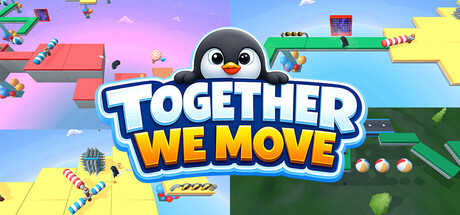
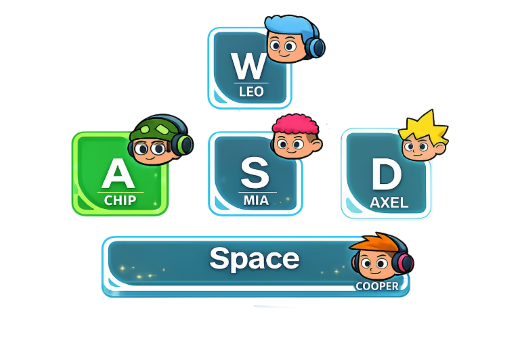
Together We Move is an inventive cooperative platforming game developed and published by KiraKami Games that turns teamwork into both the main mechanic and the main source of chaos. Instead of giving every player full control over their own character, the game divides movement inputs among several participants, forcing an entire group to operate a single character together. One player might control jumping while another handles movement in one direction, creating a constant struggle where success depends entirely on communication and synchronization. The concept sounds simple at first, but once the action begins, it becomes clear that the game is designed to challenge patience, coordination, and friendships in equal measure.
The brilliance of the game lies in how naturally it creates tension and comedy from such a minimal setup. Even walking in a straight line can become difficult when several people are attempting to coordinate at once. Every jump requires careful timing, and every obstacle becomes a group effort rather than an individual challenge. This creates a unique kind of multiplayer experience where players are never fully in control, resulting in constant moments of panic, laughter, and accidental sabotage. A single mistimed input can send the entire team falling into failure, often after several minutes of careful progress. The frustration that follows somehow becomes part of the fun, especially when everyone involved is blaming each other while trying desperately to recover.
The platforming mechanics themselves are surprisingly solid. Levels are built around precision movement, narrow platforms, awkward jumps, and environmental hazards that test the group’s ability to work together under pressure. The stages gradually become more difficult, introducing situations that require increasingly precise coordination between players. Because the game revolves around collective control, even simple platforming sequences feel fresh and unpredictable. Success never depends purely on reaction speed or technical skill alone; instead, the game constantly asks whether the entire group can remain synchronized long enough to overcome each challenge.
One of the strongest aspects of Together We Move is the way it encourages communication without directly forcing it through complicated systems. Players naturally begin shouting instructions, counting down jumps, and arguing over mistakes because effective teamwork becomes absolutely necessary for survival. The game creates the same type of energetic chaos that defines successful party games, where half the entertainment comes from the conversations happening outside the gameplay itself. The more players involved, the more ridiculous the experience becomes, especially during difficult sections where panic starts to override coordination.
Visually, the game adopts a bright and colorful art direction that fits its playful tone. The environments are easy to read, which is important considering how chaotic the gameplay can become during multiplayer sessions. Character animations are exaggerated enough to make every stumble and failed jump entertaining to watch, adding to the comedic atmosphere. While the graphics are relatively simple compared to larger platforming titles, the presentation works well because it prioritizes clarity and accessibility over realism. The clean visual style ensures that players can focus entirely on the cooperative mechanics without unnecessary distractions.
The sound design also supports the experience effectively. The soundtrack maintains a fast and upbeat energy that matches the frantic gameplay, while the sound effects provide satisfying feedback for jumps, falls, impacts, and failed attempts. Audio cues become especially useful during tense moments where players need to react quickly together. Although the music may not leave a lasting impression outside the game, it successfully reinforces the lighthearted and chaotic mood throughout each session.
Accessibility is another area where the game performs well. The control concept is easy to understand even for people who are not experienced gamers, making it an ideal choice for casual multiplayer gatherings. The challenge comes not from memorizing complex mechanics but from learning how to cooperate effectively with others. This makes the game approachable while still remaining difficult enough to keep experienced players engaged. The simple premise also means matches can quickly transition from controlled teamwork into complete disaster within seconds, which helps maintain the game’s unpredictability.
At the same time, the game’s heavy dependence on multiplayer interaction can also be its biggest weakness. Players looking for a deep solo experience or extensive progression systems may not find enough content to stay invested long term. While the core mechanic is creative and entertaining, much of the replay value relies on having an active group of friends willing to participate in the chaos. Without that social element, the experience loses much of its personality and excitement. The game is clearly designed around shared reactions and communication rather than traditional single-player progression.
Despite those limitations, Together We Move succeeds because it fully commits to its central idea. Rather than overcomplicating the formula with unnecessary systems, it focuses entirely on delivering memorable cooperative moments built around communication, confusion, and teamwork. Every successful jump feels rewarding because it represents a genuine group accomplishment, while every failure creates the kind of hilarious frustration that multiplayer party games thrive on. The combination of simple mechanics and unpredictable player interaction gives the game a unique charm that makes it stand out among indie co-op titles.
Together We Move may not offer the depth of larger multiplayer releases, but it understands exactly what kind of experience it wants to provide. It is a chaotic, funny, and surprisingly tense platformer that transforms basic movement into a shared challenge where teamwork matters more than individual skill. For players who enjoy cooperative games that create loud, energetic, and often ridiculous multiplayer moments, it delivers a consistently entertaining experience that becomes even better with friends.
Rating: 7/10