You play whose family was executed under the orders of a ruthless king Through years of cunning strategy and dangerous alliances, you lead a rebellion and seize the throne for yourself. But the crown is no sanctuary. Years later, just as you begin to rebuild the realm an assassin’s blade finds you.
Modeled estimate, not a reported figure. How we estimate →
Media

About
Every kingdom starts with a betrayal.
Years ago, your family was slaughtered under the banner of a tyrant king.
Now, after years of strategy, deceit, and rebellion—you’ve taken the throne for yourself. But power has a price. As the crown rests heavy on your head, a darker game begins…
Just when peace seems within reach, you’re struck down by an assassination attempt.
You survive—but barely. Years have passed.
You’re older. Slower. And now… you’re not the only one who bleeds for truth.
Your son takes up the mantle. Together, you must uncover who is behind the dagger… and why your reign still threatens the shadows in your kingdom.
🏰 A rich, grounded medieval visual novel
🤝 Over 100 impactful choices that shape your path
🔀 Multiple endings based on your loyalty, cruelty or mercy
🔍 A dual-timeline narrative: from rebellion to revenge
🎭 Complex characters, political tension, family, betrayal
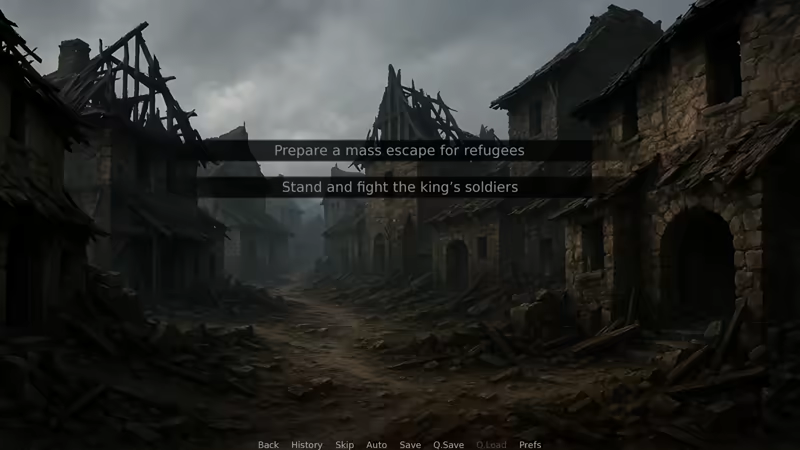
🎨 Stunning ultra-realistic art and handcrafted scenes
Will your bloodline bring peace to the realm—or drown it in civil war?
The images not found error you see in the trailer or images does not exist in the game . 1v1 duels shaped by your choices.
Stats
All-time low is the lowest price we've recorded for this game since we started tracking it.
Languages: English, Russian, German, Spanish - Spain
Reviews
I was really looking forward to this game. The developer said they would get better with every game. I’ve only played about 10 minutes so far, but I’m enjoying it and I’ll definitely finish it.
ThroneBreaker by Kingdoms Games is a story-driven medieval RPG that places narrative weight, political tension, and moral consequence at the center of its design. Rather than pursuing scale or spectacle, the game focuses on the personal journey of power—how it is taken, how it is justified, and how it ultimately reshapes the person who holds it. From the opening moments, the tone is somber and deliberate, establishing a world ruled by cruelty and betrayal where the fall of a family becomes the catalyst for rebellion. What begins as a revenge-fueled uprising slowly evolves into a broader meditation on leadership, responsibility, and the cost of ruling, giving the experience a sense of progression that feels thematic rather than mechanical. The narrative backbone of ThroneBreaker is its strongest asset, built around choice-driven storytelling that rarely offers comfortable answers. As the protagonist rises from exile to challenger and eventually ruler, the game repeatedly forces players to confront dilemmas that pit idealism against survival. Decisions are rarely framed as good or evil; instead, they exist in morally gray spaces where every option carries trade-offs that ripple through the kingdom. Alliances may secure short-term stability but sow resentment, while merciful choices can weaken authority in a world that respects strength above all else. This constant tension between compassion and pragmatism gives the story emotional weight and ensures that the act of ruling feels burdensome rather than triumphant. Mechanically, ThroneBreaker blends light RPG systems with elements of strategy and adventure, but always in service of the narrative. Combat encounters are present, yet they are not the primary focus; instead, they act as narrative punctuation, reinforcing the stakes of the unfolding conflict. Resource management, troop readiness, and political influence play a more prominent role, encouraging players to think like leaders rather than warriors. These systems are intentionally restrained, avoiding complexity for its own sake and ensuring that they never distract from character development or story flow. The result is a game that feels cohesive, where mechanics support storytelling rather than compete with it. The game’s pacing reflects its narrative ambitions, unfolding steadily and giving players time to absorb the consequences of their actions. Dialogues are written with an emphasis on tone and implication, often revealing as much through what is left unsaid as through explicit exposition. Key characters are given room to develop over time, with relationships shaped by the player’s decisions rather than fixed arcs. Some companions may grow loyal, others distant or openly hostile, depending on how you wield authority. This dynamic approach to character interaction strengthens immersion and reinforces the sense that the world is reacting to your leadership rather than simply accommodating it. Visually, ThroneBreaker adopts a stylized, understated aesthetic that prioritizes atmosphere over realism. Environments and character art evoke a bleak medieval setting, reinforcing the themes of decay, hardship, and political instability. The presentation may appear modest compared to larger productions, but it remains consistent and purposeful, allowing the story to remain the focal point. Sound design and music further enhance the mood, using restrained compositions to underscore moments of tension, loss, or quiet reflection without overwhelming the narrative. Together, these elements create an experience that feels intimate and somber rather than epic in a traditional sense. Ultimately, ThroneBreaker is a game that succeeds by knowing exactly what it wants to be. It does not attempt to rival large-scale RPGs in scope or mechanical depth, instead delivering a focused, emotionally grounded journey centered on power and consequence. Its strength lies in its writing and its willingness to challenge players with uncomfortable decisions that linger long after the credits roll. For those who value narrative-driven experiences, political intrigue, and morally complex storytelling over constant action, ThroneBreaker offers a thoughtful and memorable exploration of what it truly means to win a throne—and what it costs to keep it. Rating: 6/10
Related
Related
Trends
Concurrent players on Steam, sampled daily since tracking started.
Momentum
Pace estimated from the game's recent review growth (our daily snapshots) at its own sales-per-review ratio — a momentum signal, not booked sales.
Related
| 7 Days to Die | $457.9M | 275.4K | 87% | $44.99 |
| Mount & Blade II: Bannerlord | $413.7M | 227.5K | 88% | $49.99 |
| Clair Obscur: Expedition 33 | $243.3M | 273.1K | 95% | $49.99 |
| Stardew Valley | $243.2M | 1M | 98% | $14.99 |
| Palworld | $231.3M | 374.6K | 94% | $20.99 |
| Project Zomboid | $181.2M | 349.3K | 94% | $19.99 |
Related
| Glasses and Girls | $315.6 | 51 | 82% | $0.49 |
| Bongo Quest | $315.6 | 51 | 45% | $0.49 |
| Food and Girls | $315.6 | 51 | 86% | $0.49 |
| Dances and Girls | $322 | 52 | 83% | $0.49 |
| Anime Sunset Ride | $334.4 | 54 | 67% | $0.49 |
| Carnival and Girls | $334.4 | 53 | 85% | $0.49 |