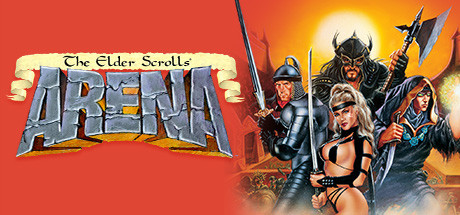
The Elder Scrolls: Arena represents the beginning of one of the most celebrated role-playing franchises ever created, introducing players to the sprawling fantasy world of Tamriel long before open-world RPGs became commonplace. Developed and published by Bethesda Softworks, the game follows the player's quest to defeat the Imperial Battlemage Jagar Tharn after he imprisons Emperor Uriel Septim VII through deception and powerful magic. Although its presentation reflects the technological limitations of the mid-1990s, Arena remains an ambitious adventure whose scale and freedom continue to impress. The Steam release preserves this landmark title, allowing modern audiences to experience the foundation upon which the Elder Scrolls series was built.
The game's most remarkable achievement is the sheer size of its world. Rather than restricting players to a handful of maps, Arena offers an expansive version of Tamriel filled with countless cities, settlements, wilderness regions, and perilous dungeons. Exploration is central to the experience, as players travel across provinces searching for pieces of the legendary Staff of Chaos while encountering side quests, merchants, guilds, and hidden dangers along the way. Even decades after its original release, the sensation of venturing across such a massive fantasy continent remains one of the game's defining strengths. The world feels mysterious and inviting, encouraging players to wander beyond the main objective to uncover valuable equipment, powerful enemies, and unexpected discoveries.
Character creation provides considerable flexibility, allowing players to select from multiple races and classes that significantly influence combat styles and progression. Whether choosing to specialize in heavy weapons, ranged attacks, stealth, or powerful spellcasting, every build offers a distinct approach to overcoming the game's many challenges. The magic system is especially robust for its era, featuring a broad selection of offensive, defensive, and utility spells that become increasingly important as the adventure unfolds. Equipment upgrades, attribute growth, and resource management all contribute to a satisfying sense of progression that rewards patience and thoughtful planning.
Dungeon exploration serves as the heart of the gameplay, delivering sprawling underground complexes filled with monsters, traps, puzzles, and hidden treasures. These labyrinths are intentionally confusing, often requiring careful navigation while managing limited health, spell points, and supplies. Every descent carries a sense of danger, making successful expeditions feel rewarding. The unpredictable nature of these environments creates genuine tension, particularly when powerful enemies lurk around narrow corridors or valuable artifacts are hidden deep within dangerous chambers. The game successfully captures the excitement of classic dungeon crawling, where every victory feels earned rather than handed to the player.
Combat, while undeniably dated by modern standards, still demonstrates the experimental spirit of early first-person role-playing games. Weapon swings are controlled through mouse movements, creating a unique system that was innovative during its original release. Battles require more than simply attacking repeatedly, as positioning, preparation, and effective use of magic all contribute to survival. Different enemy types encourage players to adapt their tactics, while stronger equipment and advanced spells gradually transform the protagonist from a vulnerable adventurer into a formidable hero capable of confronting increasingly dangerous threats.
The story itself embraces classic high fantasy themes of betrayal, political intrigue, and the struggle to restore order to a fractured empire. Although the narrative is relatively straightforward compared to later entries in the series, it effectively motivates players to explore every corner of Tamriel while gradually uncovering the larger conflict surrounding Jagar Tharn's rule. More importantly, Arena introduces many of the races, locations, lore, and historical foundations that would become central to future Elder Scrolls games. For longtime fans, the title offers fascinating insight into how the universe evolved over subsequent decades.
Naturally, newcomers should expect several rough edges. The interface can be difficult to navigate, quest guidance is minimal, and many mechanics reflect design philosophies from an earlier era of PC gaming. Some dungeons become repetitive due to procedural generation, while the game's steep learning curve may frustrate players accustomed to modern conveniences. However, these shortcomings are balanced by the game's extraordinary ambition and willingness to give players complete freedom to approach the adventure at their own pace.
Even after many years, The Elder Scrolls: Arena remains an important milestone in RPG history. Its enormous world, emphasis on player choice, extensive character customization, and rewarding exploration established ideas that would later define not only the Elder Scrolls franchise but also countless open-world role-playing games that followed. While its age is impossible to ignore, those willing to embrace its old-school design will discover a rewarding fantasy adventure that still captures the thrill of exploration and discovery. It stands as both a compelling game in its own right and an essential piece of gaming history that showcases Bethesda Softworks' early vision for one of the industry's most enduring series.
Rating: 8/10