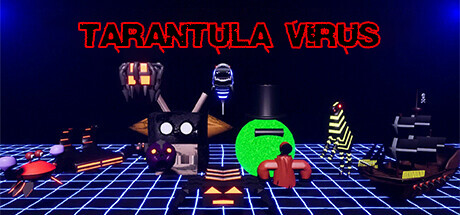
Tarantula Virus is a compact science-fiction action roguelike that builds its identity around procedural stages, hectic top-down shooting, extensive item combinations, and a distinctive overheating mechanic. Developed and published by Kamil Graca, the game places players in control of a robot attempting to save a digital world from the destructive Tarantula Virus. As the infection spreads, increasingly dangerous enemies and bosses stand between the player and the source of the threat. The premise is intentionally straightforward, providing enough context to support a gameplay-focused experience where surviving unpredictable combat encounters is far more important than following an elaborate storyline.
At its core, Tarantula Virus follows the familiar rhythm of an action roguelike. Levels are randomly generated, meaning each attempt can present different situations rather than forcing players through an identical sequence every time. Exploration quickly turns into combat as infected creatures and mechanical threats occupy the environment. The top-down perspective provides a useful overview of the battlefield, which becomes particularly important once projectiles, enemies, and visual effects begin competing for space. Its combination of roguelike progression and bullet-hell influences encourages players to remain mobile, recognize enemy patterns, and make quick positioning decisions.
The most interesting complication is the overheating system. Both movement and aggressive shooting contribute to the character's heat, and reckless play can eventually force the robot to stop temporarily. This changes the usual expectations of a fast top-down shooter. Constantly firing while moving may initially seem like the safest strategy, but Tarantula Virus asks players to regulate that behavior. Managing heat becomes another survival consideration alongside health, positioning, enemy attacks, and damage output. Getting caught in a vulnerable state during an intense encounter can be costly, so successful play involves understanding when to attack aggressively and when to ease off.
A considerable amount of replay value is intended to come from the game's collection of more than 200 items. These items can also be upgraded, creating opportunities for different combinations and increasingly powerful character builds. Because roguelikes depend heavily on making repeated runs feel worthwhile, such a large pool of equipment gives Tarantula Virus an important source of variety. Some attempts may produce highly effective combinations, while others force players to improvise with less convenient options. New characters can also be unlocked, and allies can be discovered, expanding progression beyond simply collecting stronger equipment.
Boss battles serve as major tests of whatever build the player has assembled. With more than 15 bosses advertised, there is a respectable assortment of larger opponents to encounter. These battles naturally complement the game's bullet-hell characteristics because bosses can place greater pressure on movement, timing, heat management, and offensive efficiency. A strong collection of upgrades can make these encounters considerably easier, but the overheating mechanic prevents raw aggression from becoming the only consideration. Players still need to control their actions rather than simply holding down the attack button until the enemy disappears.
Presentation supports the game's digital science-fiction premise with a 3D futuristic aesthetic, dynamic lighting, visual effects, and an emphasis on mechanical environments and characters. The visual direction gives the game a recognizable technological atmosphere appropriate for a story about a robot fighting a computer-like infection. It is not attempting to compete with large-budget action games in terms of environmental complexity, but its visual effects help give combat energy and make the corrupted digital world more convincing. The futuristic style also ties the mechanical gameplay systems to the setting rather effectively.
Another welcome feature is cooperative play. Tarantula Virus supports shared and split-screen cooperation along with Steam Remote Play Together, allowing its randomized combat to become a multiplayer experience. Cooperative support suits the design particularly well because chaotic enemy encounters can become more entertaining when two players are coordinating attacks and managing threats together. Controller support further makes local multiplayer more practical. For solo players, however, the game remains completely playable as a single-player experience, so cooperation functions as an additional mode rather than a requirement.
There are also 22 Steam achievements, providing additional objectives for players who enjoy completion-oriented progression. Combined with randomized stages, unlockable characters, allies, upgradeable items, numerous bosses, and cooperative play, these achievements contribute to the game's emphasis on repeated sessions. Tarantula Virus is clearly designed around replayability instead of a lengthy linear adventure. Its relatively modest technical requirements and small storage footprint also make it accessible to players without particularly high-end hardware.
The main weakness is that many of its individual ingredients are already well established within the action-roguelike genre. Randomized levels, enormous item pools, boss encounters, unlockable characters, and increasingly powerful builds are familiar concepts. Tarantula Virus therefore succeeds more through the interaction of its systems than through completely reinventing the genre. The overheating mechanic is especially important in this respect because it introduces a meaningful restriction that distinguishes combat from shooters where uninterrupted movement and firing are almost always optimal. Players expecting extensive storytelling or deep characterization may also find the narrative relatively light, since the digital-virus premise primarily exists to establish the setting and motivate the action.
Overall, Tarantula Virus is an interesting independent roguelike that concentrates on combat, randomized progression, build experimentation, and replayability. Its more than 200 upgradeable items and substantial boss selection give players plenty to discover, while procedural levels prevent every run from unfolding exactly the same way. The overheating mechanic adds a welcome tactical wrinkle by making restraint almost as important as aggression, and cooperative support provides another way to experience its chaotic battles. Developed and published by Kamil Graca, it is a modest but thoughtfully constructed action game that should appeal most to players who enjoy repeated runs, experimentation with equipment combinations, science-fiction environments, and fast top-down combat.
Rating: 6/10