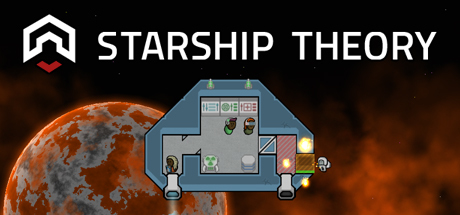
Starship Theory is an ambitious space management simulator developed and published by Reconnect Software that places players in charge of a small group of survivors attempting to carve out a future among the stars. Starting with little more than a basic spacecraft and a handful of crew members, players are tasked with transforming a fragile vessel into a thriving interstellar home. The game combines elements of colony management, resource gathering, ship construction, and tactical survival, creating an experience that often feels like a blend of a space station simulator and a sandbox strategy game. Its appeal comes from the freedom it gives players to build, expand, and adapt while dealing with the constant pressures of life in deep space.
The heart of the experience lies in ship design and expansion. Rather than operating from a fixed structure, players gradually shape their vessel according to their own vision. New rooms can be added, systems upgraded, and specialized facilities installed to improve efficiency and support a growing crew. Every expansion feels meaningful because space is limited and resources are valuable. Designing a layout that allows crew members to move efficiently while maintaining critical systems becomes an engaging challenge. The game succeeds in making players feel like genuine spacecraft architects, constantly adjusting and improving their creation to meet new demands.
Resource acquisition is equally important and serves as the engine that drives progression. Asteroids become valuable sources of raw materials, abandoned wrecks offer opportunities for scavenging, and trade encounters provide alternative methods of obtaining necessary supplies. Every decision regarding resource allocation carries consequences. Spending materials on expansion may delay essential repairs, while hoarding resources can slow overall progress. This constant balancing act gives the game a satisfying strategic depth that rewards careful planning rather than reckless growth.
The crew management systems are another highlight. Each crew member develops individual skills and contributes to the operation of the ship in different ways. Assigning tasks, improving efficiency, and ensuring the wellbeing of the crew become critical responsibilities. Characters require food, oxygen, rest, and suitable living conditions, and neglecting these needs can quickly create problems. Because the game ties survival directly to crew performance, every individual feels valuable. Watching a small team evolve into a capable and efficient workforce adds a rewarding sense of progression that extends beyond ship upgrades alone.
One of the most immersive aspects of Starship Theory is its focus on everyday survival in space. Maintaining life-support systems, managing power distribution, preventing oxygen shortages, and responding to emergencies all become part of routine operations. A single fire or system failure can create a chain reaction that threatens the entire ship. These unexpected situations inject tension into gameplay and prevent management from becoming too predictable. Even during periods of stability, there is always the feeling that a new crisis could emerge at any moment.
Combat and external threats add another layer to the experience. Hostile encounters require more than simply equipping stronger weapons. Players must consider ship positioning, system damage, heat management, and target prioritization during battles. Environmental hazards such as asteroid impacts and dangerous stellar conditions further complicate exploration. The result is a universe that feels genuinely hostile, where survival depends not only on economic success but also on preparedness and adaptability.
Visually, the game adopts a practical approach that prioritizes readability. The two-dimensional perspective provides a clear overview of ship operations, allowing players to monitor construction projects, crew activities, and system status simultaneously. While the presentation lacks the visual spectacle of larger space simulations, it effectively supports the management-focused gameplay. The clean interface and straightforward visual design make it easier to understand complex situations, which is particularly important in a game filled with interconnected systems.
The game's greatest strength is the amount of freedom it provides. There is rarely a single correct solution to a problem. Players can choose to focus on mining operations, become efficient traders, invest heavily in defensive capabilities, or concentrate on creating the most self-sufficient vessel possible. This flexibility encourages experimentation and gives each playthrough a unique identity. Fans of open-ended management games will appreciate the ability to develop their ship according to personal preferences rather than following a rigid progression path.
However, Starship Theory also shows signs of its age and unfinished ambitions. Some systems feel rough around the edges, and certain mechanics could have benefited from additional refinement. The interface occasionally requires extra effort to navigate, and some players may notice areas where the game's scope exceeds its level of polish. Those expecting the production values of major simulation titles may find these shortcomings noticeable. Nevertheless, the underlying concepts remain strong enough to keep dedicated strategy fans invested.
Despite its imperfections, Starship Theory delivers an engaging and often rewarding space management experience. Its combination of ship customization, resource management, crew development, and survival mechanics creates a compelling gameplay loop that captures the challenges of life beyond civilization. The constant need to expand, adapt, and overcome obstacles gives the game a satisfying sense of progression that keeps players invested in the fate of their crew and vessel. While it may not be the most polished title in the genre, it offers enough depth, creativity, and freedom to stand out as an enjoyable experience for fans of space-themed management and simulation games.
Rating: 6/10