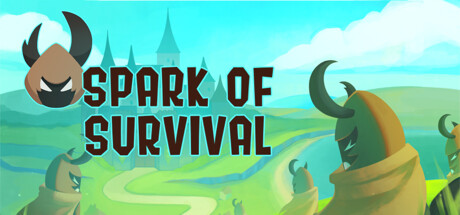
Spark of Survival is a free-to-play strategy tower defense game developed and published by AnyStudio that centers on defending a medieval kingdom from waves of hostile mechanical invaders. Presented from a top-down perspective with stylized 2.5D visuals, the game follows the familiar structure of classic tower defense titles while introducing a system of elemental towers that interact with one another in creative ways. Rather than focusing on an elaborate narrative or character progression, the experience places most of its emphasis on tactical planning, strategic positioning, and the gradual escalation of defensive challenges.
The premise of the game is straightforward but effective for the genre. A peaceful kingdom finds itself under attack from an army of robotic enemies that advance relentlessly toward its defenses. Players take on the role of the kingdom’s protector, tasked with constructing a network of towers capable of stopping the invading forces before they reach the castle gates. Although the story is not deeply developed, the contrast between the fantasy setting and the mechanical enemy designs creates an interesting thematic blend that distinguishes the game visually. The invasion of machines into a traditional medieval environment gives the battlefield a slightly unusual identity compared to many tower defense games that rely entirely on fantasy creatures.
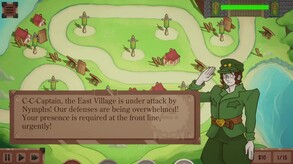
Gameplay revolves around constructing towers along pathways that enemies travel as they advance across the map. Each tower type represents a different elemental force, such as fire, ice, water, or lightning. These elements are not merely cosmetic differences; they determine how each tower interacts with enemies and with other towers placed nearby. For example, fire towers might deal strong damage over time, while ice towers slow enemies and create opportunities for other towers to deliver stronger attacks. The most effective strategies often involve combining multiple elemental towers so that their effects stack together in powerful ways.
This interaction between elements forms the heart of the game’s strategic depth. Placing towers randomly is rarely effective; players must carefully consider how enemies will move through the map and design their defenses so that different elemental attacks trigger in sequence. When executed properly, these combinations can create chain reactions that deal significantly more damage than individual towers acting alone. Discovering these synergies becomes one of the most satisfying aspects of the gameplay, as players gradually learn how to construct efficient defensive networks.
The game also allows players to upgrade their towers during a battle, adding another layer of decision-making to the experience. Upgrades can increase damage output, expand attack range, or enhance elemental effects that interact with other towers. Because resources are limited, players must choose carefully which towers to strengthen and when to invest in new defenses. In many cases, the difference between victory and defeat depends on making the right upgrade at the right moment. This resource management element encourages players to adapt their strategies as enemy waves become increasingly dangerous.
Another notable feature is the ability to reposition or sell towers mid-battle. This flexibility allows players to adjust their defensive layout if a particular strategy proves ineffective. Rather than being locked into a single arrangement for the entire level, players can experiment with new tower placements as enemy patterns evolve. This dynamic approach helps maintain a sense of control and encourages players to learn from mistakes rather than feeling punished by them.
Enemy variety plays an important role in maintaining challenge throughout the game. Different robotic enemies possess unique traits that require specific countermeasures. Some move quickly but have low durability, making them vulnerable to rapid attacks. Others are heavily armored and require concentrated firepower to defeat. As the game progresses, enemy waves introduce combinations of these units that force players to design balanced defenses capable of handling multiple threats simultaneously.
Levels are structured as a sequence of increasingly difficult stages that gradually introduce new mechanics and enemy types. Early levels serve as a tutorial, allowing players to familiarize themselves with the elemental tower system and the basic principles of placement and upgrades. Later stages become far more demanding, presenting large enemy waves that test both planning and adaptability. Successfully surviving these encounters often requires careful coordination of tower abilities and efficient resource management.
Visually, Spark of Survival adopts a bright and colorful art style that contrasts sharply with the metallic designs of the invading robots. The kingdom’s environment features lush landscapes and medieval architecture, creating a vivid setting that highlights the conflict between fantasy and technology. While the graphical detail remains relatively modest, the clear visual design ensures that players can easily track enemy movements and tower effects even during intense moments when the battlefield becomes crowded with projectiles and explosions.
The sound design complements the action with energetic effects that accompany tower attacks and enemy destruction. Each elemental tower produces distinct audio cues when activated, helping players recognize which defenses are currently engaging enemies. Background music remains fairly subtle but maintains a steady pace that supports the strategic nature of the gameplay without becoming distracting.
One of the strengths of Spark of Survival is its accessibility. The core mechanics are easy to understand, allowing newcomers to quickly grasp how towers function and how enemy waves progress through each level. At the same time, the elemental interaction system introduces enough complexity to keep experienced players engaged as they experiment with different defensive combinations. This balance between simplicity and strategic depth makes the game approachable while still offering opportunities for experimentation.
However, the game’s limited scope does create some drawbacks. Compared to larger tower defense titles, the number of levels and tower types is relatively small. Once players have mastered the available mechanics, the overall gameplay loop may begin to feel repetitive. The absence of extensive progression systems or additional modes also limits long-term replay value for players who prefer more expansive strategy experiences.
Despite these limitations, Spark of Survival succeeds in delivering a solid tower defense experience built around creative elemental interactions. The ability to combine different tower effects in strategic ways gives the gameplay a satisfying sense of experimentation, and the escalating difficulty ensures that players must continually refine their defensive tactics. While the game may not redefine the genre, it provides an enjoyable and accessible challenge for players who appreciate classic strategy mechanics.
Overall, Spark of Survival stands as a compact but engaging tower defense game that demonstrates how a simple concept can still offer rewarding strategic gameplay. Its mix of elemental towers, adaptable defenses, and escalating enemy waves creates a gameplay loop that remains entertaining even within its relatively modest scope. For fans of the tower defense genre who enjoy experimenting with defensive strategies and elemental combinations, the game offers a fun and approachable challenge.
Rating: 7/10