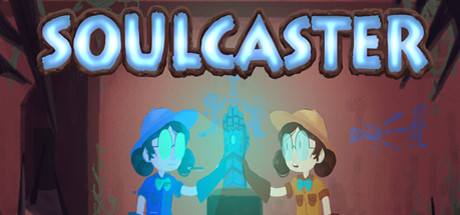
Escape an ancient temple by utilizing its arcane artifacts in an intriguing 2D puzzle plat-former.
Revenue comes from in-game items and microtransactions, which our price-based model doesn't estimate. Copies below reflect the player base, not paid sales.
Media

About


Genres
Stats
Languages: English
Engagement
Reviews
Themes across 40 recent reviews and how positive each mention is. A keyword signal, not full sentiment analysis.
Reviews
The puzzles are pretty good and from the achievements there seems to be a lot of "challenge" content even after you finish the game. On the other hand, the controls are pretty janky and I really don't like this graphic style.
nice puzzles
[h1]Before I played Soulcaster, I had a small pp, no friends, no gf, depression, and no life. These things havent changed, but the game is pretty good[/h1]
Related
Related
Trends
Concurrent players on Steam, sampled daily since tracking started.
Hours played at review time, across 40 reviews with recorded playtime.
positive critical· bar length = how often the theme comes up
serve para passar o tempo.
I'm a big fan of "archeology girl" games; I think Metroid Prime was one of the first games I considered to be truly exceptional. The curve of difficulty in rooms felt smooth, but none of them had left me completely stumped and were usually solvable with trial and error. I found that the more I started to think of the game as a sort of locksmith puzzle, the more the stone barriers began to actually take on the appearance of rising and falling tumblers. The ending of the game has a surprising amount of set-piece levels, which was a welcome change of pace to finish out on. The game has traded a quantity of Mind gameplay in favor of cementing a Land experience, using the last three levels to escort me out and an extremely simple final level to contrast the atmosphere of the "game" part of the game with a modest jungle ambience. While I was expecting more Land development to appear in the game proper, I appreciate the dedication to the principle against the odds of scoping out a whole new area, which prompts the desire for mechanics unique to that area to contrast the gauntlet; perhaps a stray magic stone from the gauntlet lets you possess monkeys or something. Maybe Steven Universe shows up with a knife. I'm not your boss. The "clone" is a popular trope in Mind games because of its ability to be immediately grasped by the player, but the breadth of its mechanical capabilities are still often novel in the context of its parallel features. The Talos Principle introduces the recorder machines in the second area, when they have familiarized themselves with a handful of other elements such as barriers and jammers. The small sequence of Portal where your portals are placed for you is doing some work towards the illusion that the facility predates the gun and the buttons and crates within are not necessarily for the gun, even though in a game sense this is clearly the case. Although other elements are introduced prior to the clone mechanic, elements which are introduced afterward are dependent on the casting ability and could have done with more elegant connection between each other. Switches could cause a channel of wind to blow away fog, or some of the barriers could be red herrings, instead requiring you to stack boxes and jump over them. Scope creepers aside, among the "archeology girl" games, Uncharted is one where Nate just needs to ditch the guns and stick to stunts; props to you for sticking to your gauntlet. Soulcaster gets an A for Archaeology, Delved and Delivered.
It took me 34 minutes to complete all ~20 levels on a Steam Deck. It says controller recommended, but I felt it actually would have worked better with keyboard and mouse because aiming where to spawn the clone with a joystick never felt right to me. Sometimes it didn't seem to move very much. Other times it moved really quickly. It would have been much easier and faster to be able to point my mouse in the direction or at the location I wanted to spawn the clone. In fact, after a while I began to suspect that maybe moving the joystick was actually moving an invisible mouse cursor around the screen. So pressing one way or another may have made a large or insignificant change in the aiming direction depending on where the invisible cursor was relative to my character's position. But I didn't take the time to test that hypothesis. The graphics are simple, but passable. I had the volume turned down pretty low, so I can't really comment on the sound effects and music. I could hear that there was music, but I couldn't really hear it. If it's anything like the music from the trailer, that's probably a good thing, as the trailer's music is a bit grating on the ears. There was really only one puzzle that I had any trouble with, I think it was level 18. Basically the last real puzzle before you return the gauntlet. The trouble for me wasn't in figuring out what to do. Rather, the problem I had was remembering to keep track of both my character and the clone at the same time while pushing blocks around. I kept forgetting to keep an eye on one or the other and ended up falling off a ledge and having to reset the level to get back up. Maybe I missed the "trick" for dealing with that, but I had to be more deliberate in my actions and take a few extra minutes to repeatedly hop over blocks so I could push or pull them from the other side while still keeping track of the other character to make sure she didn't fall down in the process. I don't know how much time the students were given to work on this project, but I'd say it was a success. I didn't encounter any game-breaking bugs. The puzzles seemed to get progressively more difficult, and kept introducing new concepts every so often to keep things from feeling too stale too quickly. It's nothing groundbreaking or amazing, but it's competently made and should keep you busy for about 30-45 minutes. Or even longer if you want to go for 100% of the achievements.
This a really fun short puzzle game, especially for free. Even though the puzzles are relatively easy there are a few that did take me a little while to figure out. I'd like to see the developers make a longer more fleshed out game with these mechanics and I think this is a good basis if that is the plan. Overall it's free, runs without issue, its quite short but it has some achievements which present challenges that make it re-playble and has some fun puzzles; you might as well download it and try it out.
Soulcaster is a project of the DigiPen Institute of Technology, who regularly release games of their students for free on Steam. Soulcaster's story features a little girl, that got trapped inside of a Pyramid and has to find her way out of that maze of rooms through solving platform puzzles. The gameplay of Soulcaster consists of a mix of Platforming and Puzzle elements (it uses a 2D side perspective). The special feature of the game is its clone gauntlet, which allows the player to create a duplicate shadow version of the protagonist. The shadow clone can be positioned via the gauntlet on any point within the view perspective of the player and he can switch positions with his clone through the gauntlet as well, as long as they keep the eye contact. The clone will move in the same direction as the player, so that he can be used for example to access a switch on the other side of the room and so on. During the later levels there are also areas, which can only be entered by the shadow version and areas, that do not permit the usage of the gauntlet at all. The levels throughout the game get progressively more challenging, but never really strain your nerves and should also be accessible to people, who are not really into puzzle games. Sadly the levels and the game are a bit short (every room is a level), so that one should be able to beat it in around 30 mins. Thankfully the game has a bit of replay value through its achievements, which motivate players to complete the game quicker and through less interaction with the clone (There is also a secret ending to be discovered). I liked the gameplay and the clone mechanic and I also appreciated the scenario of being trapped inside of a pyramid and having to solve puzzles in order to find your way out. The background visuals also fitted that scenario well, even though the overall visuals were certainly nothing majorly impressive. The soundtrack consists of only 1 theme, that loops throughout the game, but it does catch the atmosphere quite well. The movement in the game was ok for a puzzle game, but would have definitely been too clunky to satisfy in a pure platforming game. Soulcaster may only be a student project and a short game, but it is a good game nonetheless. The gauntlet works well and the gameplay is generally fun. It would have just been appreciated, if the levels were bigger and there were just a lot more of them. 6.5/10
A fun puzzle platformer game that's neither too hard or too easy. Lotta fun and glad I played it 👍
很有意思的免费小游戏,你可以召唤一个自己的复制,通过空间的不同触发机关过关,15.17关有点难,总的只有18关,19.20.21关就是凑数的,值得收藏入库,如果后面推出更多玩法和关卡的话,付费也值得!
Momentum
Pace estimated from the game's recent review growth (our daily snapshots) at its own sales-per-review ratio — a momentum signal, not booked sales.
Audience
Estimated from the language of this game's reviews — a proxy for where players are, not official Steam demographics.


