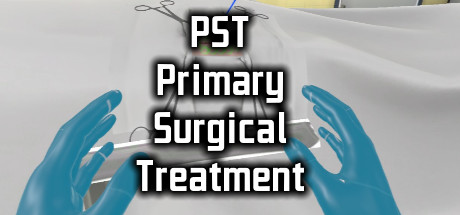
PST VR (Primary Surgical Treatment) is a virtual reality medical simulation developed and published by Adelante LTD that attempts to demonstrate the basic process of treating a wound in a clinical environment. Unlike most VR titles that focus on entertainment, combat, or exploration, this project is structured more like a training exercise designed to showcase how virtual reality can be used to simulate real-world medical procedures. The experience places players inside a virtual operating environment where they interact directly with surgical instruments and follow a sequence of steps required to perform a basic primary surgical treatment. The concept is centered on education and demonstration rather than storytelling or traditional gameplay progression.
The simulation begins by introducing the player to a clinical setting where preparation for the procedure must take place. Before interacting with the patient, the player performs a number of preparatory actions that mirror the standard practices of a real surgical environment. This includes washing hands, putting on gloves, and organizing the necessary tools for the operation. These introductory steps are important because they establish the structure of the simulation, emphasizing that each stage of the treatment must be completed in a specific order. By guiding the player through these initial preparations, the game attempts to replicate the workflow of a real medical setting while also teaching the player how to interact with the tools provided in the virtual space.
Once the preparation phase is complete, the player begins the actual treatment process. The core of the experience involves examining a wound and performing several actions required to treat it properly. Players use motion-controlled VR interactions to pick up surgical tools, position them correctly, and perform various tasks related to the procedure. Because the game is built specifically for VR systems, the mechanics rely heavily on natural hand movements rather than traditional button inputs. Tools must be physically picked up, rotated, and applied to the appropriate areas, creating the sensation of handling real medical equipment. This approach helps create a sense of immersion that would be difficult to achieve through standard screen-based simulations.
The gameplay is structured around a clear sequence of steps that represent the stages of primary surgical treatment. Players must carefully examine the wound, clean and expand the affected area using the appropriate instruments, and then carry out the treatment in the correct order. Each stage must be completed successfully before the next one becomes available. This step-by-step progression encourages players to understand the logical flow of the procedure rather than simply experimenting randomly with tools. By requiring the correct order of actions, the simulation reinforces the importance of process and accuracy in medical practice.
To help players understand these steps, the game includes two primary modes: a guided training mode and a test mode. In training mode, players receive instructions and hints that explain what needs to be done at each stage of the procedure. This mode functions almost like a tutorial, allowing players to familiarize themselves with the tools and the sequence of actions required to complete the treatment. Test mode removes many of these hints and challenges players to perform the entire procedure using their own knowledge. This structure transforms the experience into a learning exercise where players can practice the procedure repeatedly until they feel confident completing it without assistance.
The visual design of PST VR is functional rather than elaborate. The operating environment is clean and simple, focusing primarily on the patient, the surgical table, and the tools required for the procedure. Character models and medical equipment are presented with basic but recognizable detail so that players can easily identify each object. The graphics do not attempt to deliver cinematic realism or highly detailed environments; instead, they emphasize clarity and usability. Because the main objective is to simulate the use of surgical tools, the straightforward visual design helps keep the player’s attention on the procedure itself rather than on environmental distractions.
From a technical standpoint, the game includes features designed to enhance the feeling of interacting with physical objects. Surgical tools are modeled with attention to their real-world shapes and functions, and the game attempts to simulate soft-body physics when interacting with the wound. This allows instruments to behave in a way that loosely mimics their real-life counterparts. Although the simulation is relatively basic compared to professional medical training software, the effort to include realistic interaction mechanics shows the developers’ intention to explore VR as an educational platform rather than purely a gaming experience.
However, the game’s limited scope becomes apparent fairly quickly. The simulation focuses primarily on a single medical procedure, meaning that the variety of activities available to the player is quite narrow. Once players have completed the training and test modes and become familiar with the procedure, there is little additional content to explore. The project was originally released in Early Access with plans for expanded features and additional scenarios, but the current version still feels more like a demonstration of a concept than a fully developed simulation platform.
This limited amount of content may leave players expecting a deeper experience somewhat disappointed. The interaction mechanics can also feel slightly rough in places, as VR object manipulation occasionally lacks the smoothness found in more polished titles. Because of its experimental nature, the game sometimes feels more like a prototype showcasing the possibilities of VR-based education rather than a complete product designed for long-term engagement.
Despite these shortcomings, PST VR offers an interesting glimpse into how virtual reality technology could be used for educational simulations. The ability to practice procedural tasks through immersive interaction has clear potential for training environments, particularly in fields where hands-on experience is essential. Even though the current implementation is relatively simple, the concept behind the project demonstrates how VR could provide an engaging way to teach practical skills.
Overall, PST VR (Primary Surgical Treatment) is best understood as an experimental educational simulation rather than a traditional game. Its focus on demonstrating the steps of a medical procedure through immersive VR interaction is a creative idea, even if the final execution remains somewhat limited. For players curious about medical simulations or interested in seeing how VR can be applied to training environments, the experience offers a brief but intriguing look at the potential of the technology. However, those expecting a fully featured VR game or an extensive medical simulator may find the experience too short and underdeveloped to hold their attention for long.
Rating: 5/10