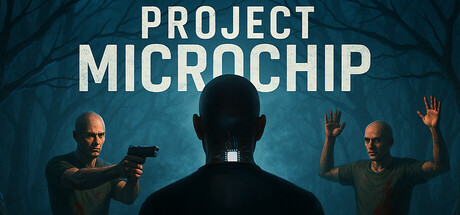
Project Microchip is a multiplayer survival and social-deduction game that combines hidden identities, cooperation, scavenging, deception, and sudden confrontations. Developed and published by Gustsoft, it places as many as ten participants into matches where nobody can be completely certain that the person helping them is actually on their side. Rather than making deduction entirely dependent on conversations and voting, the game surrounds its hidden-role concept with physical objectives and survival mechanics, giving players practical responsibilities while suspicion gradually spreads through the group.
Participants are divided between Survivors and Infected, with one to three Infected potentially hiding among everyone else. Survivors understand that hostile players have infiltrated the group, but determining their identities is another matter. An apparently dependable teammate may genuinely be working toward escape, or that same person could simply be building trust before striking at a vulnerable moment. This uncertainty turns ordinary cooperation into a calculated risk and gives player behavior considerable importance.
The identity system reinforces that uncertainty by limiting the usual visual information players receive about one another. Characters share the same general appearance, while identification is associated with the Microchip positioned on the back of the neck. Without the convenience of obvious labels constantly distinguishing everyone, participants need to pay closer attention to actions, positioning, communication, and suspicious behavior. Someone wandering away from an objective or repeatedly appearing near unfortunate incidents can quickly become the subject of accusations.
Survivors cannot spend the entire match debating who seems suspicious because they also have objectives to complete. Exploration and scavenging are necessary, with abandoned vehicles providing equipment and resources needed to repair the vehicle intended for escape. This creates useful tension between staying together for protection and separating to accomplish tasks efficiently. Remaining in a large group may feel safer, but spreading out can accelerate progress while simultaneously creating ideal opportunities for an Infected player.
Microchip overload introduces another concern that participants must manage alongside the broader objective. Equipment collection, survival pressures, and the use of tools such as the Scanner prevent matches from becoming purely conversational. These mechanics give Survivors meaningful ways to investigate and progress while also giving hidden enemies believable excuses for moving around the environment. An effective Infected player can appear productive for much of a match, making the eventual betrayal considerably more convincing.
Playing as the Infected offers a very different style of strategy. Immediate aggression is not necessarily the smartest approach because revealing hostile intentions too early can allow Survivors to organize against the threat. Pretending to cooperate can be far more effective. Helping with objectives, traveling alongside other participants, and behaving like an ordinary Survivor can gradually establish credibility. Once trust has been earned, isolating or misleading another player becomes much easier.
Xenoflesh gives the Infected access to transformation, allowing the game to shift from quiet paranoia into direct confrontation. The timing of this transformation can become an important tactical decision. Revealing yourself prematurely may sacrifice the advantages provided by anonymity, while waiting too long can give Survivors enough time to repair their escape vehicle. When multiple Infected are present, coordination can make betrayals particularly dangerous, especially if several attackers reveal themselves during a carefully prepared ambush.
This movement between uncertainty and open danger is one of Project Microchip's strongest qualities. A relatively calm scavenging sequence can become tense simply because another participant begins behaving strangely. Likewise, someone who has spent most of the match appearing trustworthy can suddenly become the greatest threat. The best moments are therefore likely to emerge organically from player interaction rather than from scripted events.
Communication naturally plays a major role. Accusations need explanations, suspicious behavior can be defended, and alliances may form around incomplete evidence. Skilled deception can be just as valuable as mechanical ability because convincing Survivors to distrust one another reduces the need for direct confrontation. On the other side, observant Survivors can potentially identify inconsistencies before an Infected player has an opportunity to execute a plan.
The disadvantage of this design is its dependence on the quality of the multiplayer group. Social-deduction games become significantly more entertaining when participants communicate and genuinely engage with their roles. Matches involving silent, disruptive, or uninterested players can lose much of the psychological tension. A consistent group of friends is therefore likely to provide the most reliable experience, particularly because coordinated communication allows the deception mechanics to reach their full potential.
Project Microchip also needs to be understood as a hybrid rather than a dedicated survival simulator. Scavenging, equipment, objectives, and survival pressures are important, but they primarily exist to support the hidden-role conflict. Likewise, the action elements become most interesting because players cannot initially determine where the threat is coming from. Anyone expecting extensive crafting or a substantial narrative campaign may find the focus narrower than anticipated.
The visual presentation supports the darker tone and the need for uncertainty. Similar-looking participants reinforce the difficulty of identification, while the environment provides enough space for exploration, scavenging, separation, and ambushes. The atmosphere works particularly well with the game's social structure because isolation immediately feels dangerous when one of the nearby players could secretly be hostile.
Steam Deck compatibility is possible but comes with compromises. The experience should not be regarded as perfectly optimized for Valve's handheld. Some functionality may require touchscreen interaction, the virtual keyboard, or adjustments to the default controller configuration, and players may encounter interface prompts intended for keyboard and mouse or other controllers. Because communication is so important to social deduction, handheld users may also find voice or text interaction less convenient than on a standard PC setup.
Overall, Project Microchip has an appealing foundation because it gives social deduction a more physical survival structure. Repairing an escape vehicle, searching for resources, controlling Microchip overload, investigating with the Scanner, hiding an Infected identity, consuming Xenoflesh, and choosing the right moment to transform all contribute to matches where trust can disappear very quickly. Its longevity depends heavily on an active community and engaging participants, but with a communicative group, the combination of paranoia, cooperation, survival, and betrayal can produce unpredictable and memorable encounters.
Rating: 6/10