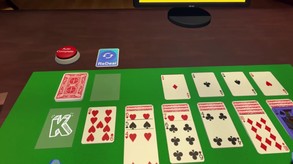
Power Solitaire VR is a delightful version of the Klondike solitaire card game that introduces unique game play only possible in Virtual Reality. Play alone, against an intelligent robot, or live multiplayer with others online. It's a social VR game the whole family already knows how to play.
Revenue comes from in-game items and microtransactions, which our price-based model doesn't estimate. Copies below reflect the player base, not paid sales.
Media

About
Genres
Stats
All-time low is the lowest price we've recorded for this game since we started tracking it.
Languages: English**languages with full audio support
Engagement
Reviews
Themes across 41 recent reviews and how positive each mention is. A keyword signal, not full sentiment analysis.
Reviews
オンラインマルチプレイは遊んでいないのでわかりませんが、オフラインに限ればごくごく普通のソリティアです。オフィスに出勤し、デスクに向かい、仕事をサボって誰にも邪魔されずにソリティアを遊ぶVRシミュレーションができます。ただそれだけのゲームですが、カードの巨大さをその手で感じたり、自分の腕でカードを動かす面倒さや、適当においたカードがきれいに並んでいく奇妙さを味わったりと、VRゲームならではの便利さと不便さが合わさった不思議な感覚を味わえます。 無料なので、VR機器をお持ちなら試してみても良いと思います。
Power Solitaire VR is a simple VR game that brings the classic card game of solitaire to life in a whole new way. Solitaire, being one of the oldest modern card games, has always been a beloved pastime. The single-player mode offers a captivating VR experience, mimicking the traditional gameplay we all know and love. Additionally, the multiplayer mode adds a new layer of enjoyment, allowing friends to challenge each other in a fun and competitive way. https://www.youtube.com/watch?v=nPuceZJFh_4
Related
Related
Trends
Modeled estimate over time.
Hours played at review time, across 41 reviews with recorded playtime.
positive critical· bar length = how often the theme comes up
Power Solitaire VR, developed and published by Parkerhill Reality Labs, takes one of the most familiar and traditionally low-intensity card games and reimagines it within a fully immersive virtual reality space. At its core, it remains faithful to classic solitaire rules, but the way players interact with the game is fundamentally transformed. Instead of clicking cards on a screen, players physically reach out, grab, and place them in a virtual environment, turning what is usually a passive experience into something more tactile and engaging. The transition from a flat interface to a 3D space is where the game finds most of its identity. Handling cards with motion controls introduces a sense of presence that is rarely associated with solitaire. Each action feels more deliberate, as players physically move their hands to manipulate the layout. This adds a layer of immersion that makes even a familiar activity feel refreshed, particularly for those experiencing it in VR for the first time. The pace of the game becomes slightly more relaxed as a result, not because it is slower mechanically, but because the interaction itself encourages a more mindful approach. One of the game’s more interesting additions is its competitive multiplayer mode, which introduces a twist to the traditional formula. Instead of playing alone, multiple players work through their own solitaire setups simultaneously, but with shared elements that allow them to influence each other’s progress. This creates a surprisingly dynamic environment where speed, timing, and awareness become important factors. The social aspect, combined with voice communication and visible avatars, transforms solitaire into something far more interactive than expected. It shifts the tone from quiet and solitary to lively and occasionally chaotic, depending on the players involved. At the same time, the multiplayer experience is heavily dependent on having an active player base. When enough players are available, it can feel fresh and engaging, offering a unique take on a classic game. When activity is low, however, the experience loses much of its appeal, as the AI alternatives do not fully replicate the unpredictability and energy of human opponents. This reliance on community is a common challenge for VR titles and is particularly noticeable here due to the emphasis on multiplayer interaction. Visually, the game opts for a clean and approachable presentation. The environments are designed to be comfortable and easy to read, avoiding unnecessary complexity in favor of clarity. While not visually groundbreaking, the design works well within the context of the game, providing a pleasant space in which to play. Small interactive details within the environment add a bit of personality, helping to prevent the experience from feeling static despite its simple premise. Accessibility is another area where the game performs well. Because solitaire is such a widely understood game, players can jump in with minimal explanation. The VR interface is intuitive enough that most interactions feel natural after only a short period of adjustment. This makes it an appealing option for players who are new to VR, as it provides a familiar foundation while still showcasing what the technology can offer. However, the game’s simplicity is also its primary limitation. No matter how immersive the presentation or how creative the multiplayer mode may be, the underlying gameplay remains unchanged. For players who are not particularly interested in solitaire, the novelty of the VR interaction may not be enough to sustain long-term engagement. Over time, especially in solo play, the experience can begin to feel repetitive, as there are few variations to the core mechanics. The physical nature of VR interaction also introduces a subtle drawback. While moving cards with your hands is engaging, it requires more effort than traditional input methods. During longer sessions, this can lead to mild fatigue, which contrasts with the typically relaxed nature of solitaire. As a result, the game is best enjoyed in shorter sessions where the novelty and immersion remain fresh. Despite these limitations, Power Solitaire VR succeeds in offering a creative and well-executed reinterpretation of a classic game. It demonstrates how even the simplest mechanics can be enhanced through thoughtful use of virtual reality, adding a sense of presence and interaction that traditional versions cannot match. The multiplayer mode, in particular, gives it a distinctive edge, turning a solitary pastime into a shared experience. In the end, Power Solitaire VR is a focused and imaginative title that delivers exactly what it promises: a new way to experience solitaire. It may not offer the depth or variety of more complex VR games, but within its scope, it provides a polished and enjoyable experience that is both accessible and unique. Rating: 8/10
This adaptation of Solitaire for Vr is amazing! Wonderful design and it works perfect! Best part about it? It's 2$! Go find some loose change in the cushions of your couch if you want a cheap and super fun Vr experience. I recommend this game to anyone that gets any enjoyment out of non virtual reality solitaire. This will give you hours of fun in the future for sure. Great Developers, Keep up the work!
1920
Bad
Cool game! I hope that the devs will bring further updates. More options in the settings menu would be good: Better graphics (possibility to increase the pixel densitywith a graphics slider for example), possibility to adjust difficulty of the robots (AI-opponents are too fast for me as a beginner; I lose every game within some seconds). Please make this good game even better!
Helps me forget the reality of me not having friends 10/10
Power Solitaire VR — увлекательная игра для любителей классических карточных головоломок в формате VR. Погружение в виртуальную реальность усиливает ощущение присутствия: карты лежат на столе, а действия выполняются руками, что делает процесс более интуитивным. Геймплей сочетает простоту сортировки карт и элементы стратегии, а разнообразные уровни и режимы держат в напряжении. Однако управление может потребовать времени для привыкания, а некоторые механики кажутся излишне простыми. Для новичков — отличный способ ознакомиться с VR, но поклонникам сложных задач может показаться скучновато. В целом — достойный выбор для досуга.
I LOVE solitaire
Momentum
Pace estimated from the game's recent review growth (our daily snapshots) at its own sales-per-review ratio — a momentum signal, not booked sales.
Audience
Estimated from the language of this game's reviews — a proxy for where players are, not official Steam demographics.