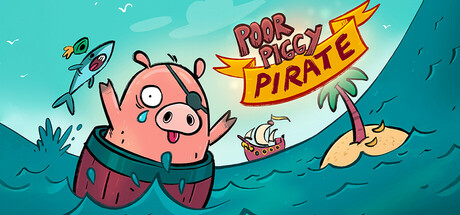
Poor Piggy Pirate, developed and published by Johannes Lott, is a compact arcade-style platformer that leans heavily into simplicity and charm, offering a light and approachable experience built around quick reflexes and score chasing. You take control of a small pig pirate navigating hazardous waters, dodging obstacles, collecting fruit, and trying to survive for as long as possible. It presents itself with a playful tone, but beneath that lies a very traditional arcade loop that focuses on repetition, improvement, and moment-to-moment awareness rather than long-term progression or storytelling.
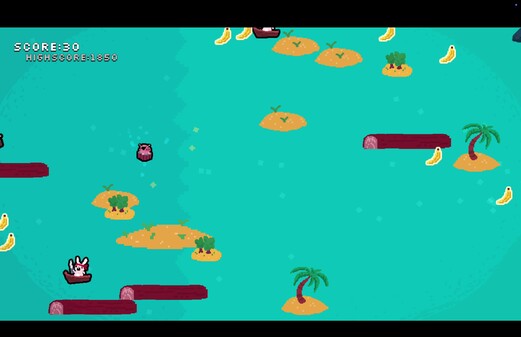
The gameplay is centered on navigating through procedurally generated stages that constantly shift in layout. Each run feels slightly different, with obstacles such as mines, rocks, and enemy hazards appearing in unpredictable arrangements. This randomness adds variety, ensuring that players cannot rely solely on memorization and instead must react in real time. Movement is straightforward and responsive, making it easy to get into the flow of the game almost immediately. However, as the pace increases and the density of hazards grows, the challenge ramps up in a way that demands sharper timing and better positioning. What begins as a relaxed experience gradually becomes more demanding, especially for players attempting to extend their runs or achieve higher scores.
The scoring system revolves around collecting fruit scattered throughout the stages. These items not only provide a clear objective but also encourage risk-taking, as some are placed in more dangerous positions. This creates a simple but effective tension between survival and reward, pushing players to decide whether to play it safe or take chances for higher scores. Over time, this loop becomes the primary source of engagement, with each run offering an opportunity to improve performance and refine decision-making.
There is also a small progression element in the form of unlockable characters. While these alternate animal avatars do not significantly change how the game plays, they add a layer of visual variety and give players a reason to continue engaging with the system. This progression is modest, but it helps break up the repetition and provides a sense of accomplishment, even if it does not fundamentally alter the gameplay experience.
Visually, the game embraces a retro pixel art style with bright, colorful environments that match its lighthearted tone. The design is intentionally simple, focusing on clarity so that players can easily identify hazards and navigate the screen during fast-paced moments. While the aesthetic is consistent and functional, it does not evolve much over time, which can make extended sessions feel visually repetitive. The environments remain largely the same, and the lack of variation reinforces the game’s limited scope.
The audio design follows a similarly minimal approach. Sound effects provide clear feedback for actions, and the background music maintains a cheerful, steady rhythm that complements the gameplay. However, there is little variation in the audio, and it tends to fade into the background rather than becoming a memorable aspect of the experience. Like the visuals, it serves its purpose without adding significant depth.
One of the most noticeable aspects of Poor Piggy Pirate is its small scale. It is clearly designed for short play sessions, where players can jump in, attempt a run, and step away without a large time commitment. This makes it accessible and easy to revisit, but it also highlights its limitations. The core mechanics do not expand or evolve in meaningful ways, and once players have experienced the main loop, there is little new to discover. The procedural generation helps maintain some variety, but it cannot fully compensate for the lack of additional systems or content.
Despite this, the game succeeds in delivering a focused and consistent arcade experience. It captures the essence of classic score-based gameplay, where improvement comes through repetition and mastery rather than unlocking new features. For players who enjoy chasing high scores and refining their skills, this can be satisfying, especially in short bursts. For others, the lack of depth and variety may make the experience feel too limited to hold attention for long.
In the end, Poor Piggy Pirate is a modest but competent indie title that does exactly what it sets out to do. It offers a simple, charming, and occasionally engaging loop that works best when approached casually. While it does not provide the complexity or longevity of larger games, it delivers a clear and accessible experience that fits well within its scope.
Rating: 7/10