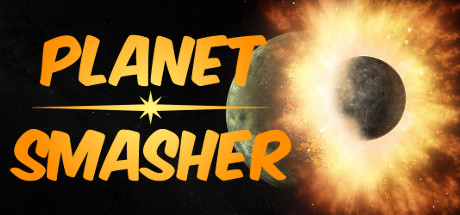
Like puzzles? Like explosions? Well then, let's smash some planets together... Play in 2D with keyboard and mouse, or turn it up to eleven and experience full-on planet smashing glory in Virtual Reality with the HTC Vive or Oculus Rift.
Modeled estimate, not a reported figure. How we estimate →
Media

About
Stats
All-time low is the lowest price we've recorded for this game since we started tracking it.
Languages: English
Engagement
Hours played at review time, across 28 reviews with recorded playtime.
Reviews
打折入的,挂卡+50比索 喜加一啊喜加一
JUPITAAAAH
Planet Smasher is a playful, physics-driven indie game that turns cosmic destruction into a casual, toy-like experience focused on experimentation and spectacle rather than strict challenge or narrative depth. Developed by Robin, Alice, Julia, and George and published by Team Gilbert, the game invites players into a colorful version of outer space where the primary objective is delightfully simple: smash celestial bodies together and enjoy the results. From the outset, it positions itself as a lighthearted sandbox that rewards curiosity, timing, and a willingness to embrace chaos. The central mechanic revolves around combining space objects through collision. Small asteroids merge into larger bodies, which in turn can become moons, planets, and eventually even more impressive cosmic formations. This loop of creation through destruction is immediately satisfying, as each successful collision produces visual flair and a sense of progress. The physics are intentionally exaggerated and arcade-like, favoring fun and unpredictability over realism. Objects bounce, explode, and react in ways that feel designed to surprise and amuse, making even simple actions engaging during the early stages of play. Visually, Planet Smasher adopts a minimalist yet vibrant presentation. The contrast between brightly colored celestial objects and the dark void of space ensures that everything remains readable, even when multiple bodies are flying around the screen. The art direction leans more toward playful abstraction than awe-inspiring realism, reinforcing the game’s identity as a casual physics toy rather than a serious space simulation. Backgrounds occasionally draw from real-world space imagery, which adds a subtle layer of polish without clashing with the cartoonish tone of the gameplay. One of the game’s more distinctive features is its support for multiple control methods, including traditional keyboard and mouse play as well as virtual reality. In VR, physically grabbing and throwing planets adds an extra layer of immersion, transforming the experience into something closer to a digital toybox. While VR does not fundamentally change the underlying mechanics, it enhances the tactile enjoyment of smashing objects together and makes the chaos feel more immediate. For players without VR hardware, the standard version still offers the same core experience, albeit in a more conventional format. Gameplay structure is intentionally loose. Rather than guiding players through a series of escalating levels or objectives, Planet Smasher encourages freeform experimentation. Achievements and leaderboards provide light goals for those who want a sense of direction, but the game never pressures players into optimal play. This openness makes it accessible and relaxing, but it also means that long-term engagement depends heavily on how much enjoyment a player derives from the core mechanic alone. This design choice is both the game’s strength and its weakness. In short sessions, smashing planets together is undeniably fun, and the feedback loop of collision, growth, and explosion remains satisfying. Over longer periods, however, the lack of evolving mechanics or meaningful variation can make the experience feel repetitive. Once the novelty of the physics interactions wears off, there is little in the way of deeper strategy or progression to sustain interest. Community reception reflects this duality. Many players appreciate Planet Smasher as a charming and stress-free diversion, praising its simple concept and satisfying physics. Others find it shallow, describing it more as an interactive demo or physics toy than a fully fleshed-out game. Neither perspective is wrong, as the game clearly prioritizes accessibility and immediate gratification over complexity or longevity. Ultimately, Planet Smasher succeeds when approached with the right expectations. It is not a deep puzzle game, nor does it aim to tell a story or challenge players with intricate systems. Instead, it offers a compact, playful space sandbox built around the joy of smashing things together and watching the universe react. For players looking for a casual indie experience, a physics playground, or a fun VR novelty, it delivers moments of genuine amusement. For those seeking structured progression or strategic depth, its simplicity may feel limiting, but as a lighthearted cosmic experiment, it fulfills its purpose with charm and enthusiasm. Rating: 5/10
фон
喜加一
•..(¯`♥´¯)(¯`♥´¯)(¯`♥´¯)¸•✿.... ........`•(¯`♥´¯)(¯`♥´¯)¸.♥ ´ .............`•(¯`♥´¯)¸.•´ .................`•.¸.•❤~☀..........
Nice ! Nice ! Nice ! Nice ! Nice ! Nice ! Nice ! Nice ! Nice ! Nice ! Nice ! Nice ! Nice !
Kartları ile kar edebilir veya oyunun parasını çıkartabilirsiniz. Daha fazla böyle oyun için incelemelerime bakabilirsiniz. İNDİRİM İLE ALIN!!
Related
Related
Trends
Concurrent players on Steam, sampled daily since tracking started.
Momentum
Pace estimated from the game's recent review growth (our daily snapshots) at its own sales-per-review ratio — a momentum signal, not booked sales.
Audience
Estimated from the language of this game's reviews — a proxy for where players are, not official Steam demographics.
Related
| Pigeon Hater | $3K | 64 | 94% | $1.49 |
| Captain fly and sexy students | $3K | 51 | 53% | $2.09 |
| You know my name? | $3K | 228 | 69% | $0.89 |
| Doughlings: Arcade | $3K | 148 | 89% | $0.99 |
| Mushroom Picker Simulator | $3K | 59 | 42% | $1.99 |
| Eron | $3K | 355 | 60% | $0.49 |