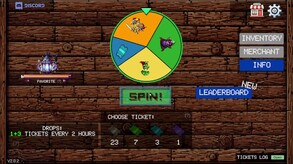
Collect Pixelart items! Get 1-4 tickets every 2 hours to spin the lucky wheel. Win pixelart items or higher rarity tickets! All items appear in your Steam inventory and are tradable/marketable, making it easier to complete your collections.
Revenue comes from in-game items and microtransactions, which our price-based model doesn't estimate. The player count below is how many people own it, not what they spent.
About

Genres
Stats
Languages: English*, French*, Italian*, German*, Spanish - Spain*, Arabic*, Portuguese - Brazil*, Bulgarian*, Traditional Chinese*, Simplified Chinese*, Danish*, Finnish* +91 more
Engagement
Reviews
Themes across 46 recent reviews and how positive each mention is. A keyword signal, not full sentiment analysis.
Reviews
Pixel Collector é mais um daqueles jogos que tentaram surfar na onda do famoso “jogo da banana”, mas que acabaram perecendo no caminho. A proposta até parece interessante à primeira vista: você abre o jogo e ganha um cupom a cada 2 horas. Foi justamente isso que me chamou atenção para testar. Porém, a vontade de jogar se perdeu rapidamente. O grande atrativo desses jogos é, sem dúvidas, o sistema de itens que podem ser vendidos no mercado da Steam. Só que aqui isso não funciona de forma interessante. Mesmo os itens teoricamente mais caros possuem encomendas na casa dos centavos. E quando você percebe isso, o jogo perde completamente o sentido, porque não existe mais nenhuma outra mecânica que te prenda. Sinceramente, a graça desse tipo de jogo está em farmar, colecionar, tentar conseguir algum item legal ou valioso... mas quando isso não existe, sobra o quê? Nada. E além dos itens serem absurdamente baratos, eles estão sem foto no mercado, o que tira completamente qualquer valor, já que o foco desse tipo de item é justamente personalizar o perfil ou colecionar visivelmente. Outro ponto que, apesar de menor, também vale ser citado é que o jogo está apenas em inglês, o que poderia ser facilmente resolvido adicionando outros idiomas. Isso não chega a atrapalhar muito, porque o jogo é simples, mas mostra a falta de cuidado dos desenvolvedores. Na minha opinião, se eles tivessem mesclado o conceito desses jogos de drops com um sistema de jogo idle, onde você faz upgrades, evolui, e tem um certo progresso, seria muito mais interessante e teria muito mais potencial para prender os jogadores. Do jeito que está, sinceramente, não vale a pena perder tempo tentando farmar algo aqui. O jogo até tinha potencial, mas foi completamente desperdiçado.
Media

Related
Related
Price dynamics, follower growth, revenue and sales trajectories with interactive tooltips
This and every other Pro feature is free until October 20, 2026. A free account is all it takes.
Hours played at review time, across 46 reviews with recorded playtime.
positive critical· bar length = how often the theme comes up
O joguinho é interessante, justamente pela proposta idle das mais simplificadas que já vi. É mais simples do que a média (não mais do que os clickers, só pra avisar), recomendo pra quem quer experimentar um jogo deste tipo, mas está na dúvida de ele "te vicia" (você praticamente não faz nada, e isso não é ruim, por incrível que pareça - só jogando pra entender), então não tem como pegar um vício.
❤️🔥Colecione itens de Pixelart! Ganhe de 1 a 4 bilhetes a cada 2 horas para girar a roda da sorte. Ganhe itens de Pixelart ou bilhetes de raridade maior! Todos os itens aparecem no seu inventário do Steam e são negociáveis/comercializáveis, facilitando a conclusão das suas coleções.🩷 💚💚ACERCA DESTE JOGO💚💚 🧡Inventário do jogo: Para visualizar sua bela coleção; 💛Comerciante: Para reciclar itens que você não quer mais; 💙Prateleira de favoritos: Para exibir seu item favorito na tela principal; 🩵Você pode obter de 1 a 4 ingressos a cada 2 horas (também um item do inventário do Steam);
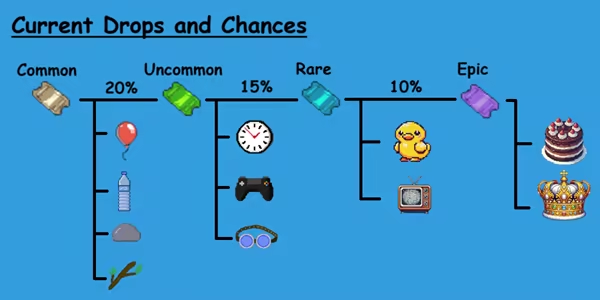
Pixel Collector is a small-scale free-to-play collecting game that builds its entire experience around acquiring pixel-art items of varying rarity. Developed and published by PixelPulseGames, it was released on July 31, 2024. Rather than offering a conventional campaign or demanding mechanical challenges, the game focuses on gradual collection building, randomized rewards, and Steam inventory integration. Its concept is intentionally straightforward, making it most suitable for players who enjoy idle progression, completing collections, and hunting for rare digital items. The basic gameplay loop revolves around tickets. Players can receive between one and four tickets every two hours, with those tickets also existing as Steam inventory items. Tickets are used to spin a lucky wheel, and the resulting reward depends on the rarity of the ticket consumed. A successful spin can produce a pixel-art collectible corresponding to that rarity or, with enough luck, a ticket of a higher rarity. This creates a simple progression cycle in which obtaining a better ticket offers another chance at increasingly desirable rewards. Scarcity plays an important role in making the system compelling. The drop probabilities are deliberately structured so that some collectibles are significantly harder to obtain than others. This means completing a collection can require considerable patience rather than a short sequence of spins. At the same time, the developer indicates that sufficiently persistent idling should eventually provide appropriate quantities from the different rarity levels within each drop pool. The result is an experience that rewards long-term participation more than mechanical skill. One of Pixel Collector's strongest ideas is its connection with Steam's inventory system. Collected items are placed into the player's Steam inventory, and the items can be tradable and marketable. This gives the rewards more significance than collectibles that exist exclusively inside an isolated game menu. Players who receive duplicates or struggle to obtain particular pieces therefore have additional possibilities for working toward a complete collection. The system also suits the game's emphasis on rarity because collectibles can retain an identity outside the immediate gameplay screen. Pixel Collector provides several basic features for managing what has been acquired. Its in-game inventory allows players to inspect their collection, while a merchant provides a method for recycling unwanted items. A favorite shelf can be used to place a preferred collectible prominently on the main screen. None of these systems is especially elaborate, but they complement the central collecting concept effectively. The game recognizes that displaying and managing collectibles can be almost as important as obtaining them. Another interesting component is the planned rotation of available drops. Rather than keeping every collectible permanently obtainable, drop selections can change periodically. The developer originally expressed an intention to aim for rotations around a weekly schedule while noting that the exact timeframe was not firmly established. Rotating pools potentially keep the experience fresh while helping individual collectibles maintain scarcity. It also gives regular players an incentive to return and investigate what can currently be obtained. The developer additionally explains that item and ticket drops are managed through Steam's inventory service. Tickets should not become available before the required waiting period has elapsed, and generating a random item requires consuming an appropriate ticket. This server-oriented approach is particularly relevant because the game's appeal depends heavily upon controlled rarity. If players could freely manipulate drops, much of the satisfaction associated with finding something uncommon would disappear. Visually, the attraction comes primarily from the collectible pixel artwork itself. The cute pixel-art direction is appropriate for a game centered on accumulating many small objects, although appreciation of those designs will naturally be subjective. Steam's disclosure also states that some artwork is inspired or generated using AI to reduce the workload on the solo developer. Since the collectibles constitute the primary rewards, players' feelings about both their appearance and the disclosed production method may influence how appealing the overall experience feels. The game's solo-development background also provides useful context for its limited scope. PixelPulseGames describes Pixel Collector as a first published game and notes that additional features were planned, while actively encouraging suggestions and feedback. This helps explain why the experience feels more like a specialized collecting platform than a feature-heavy simulation. Its minimal system requirements reinforce that lightweight character, requiring only modest hardware and storage. Steam also lists single-player play, achievements, in-app purchases, and Family Sharing among its features. The largest weakness is that the same simplicity making Pixel Collector approachable also restricts its depth. Players who want exploration, storytelling, strategic decision-making, action, or substantial hands-on progression will find relatively little of those qualities here. Much of the experience depends upon waiting, spinning, collecting, and hoping random outcomes produce desirable rewards. Consequently, enjoyment relies heavily on whether the player already finds rarity hunting and digital inventory management satisfying. Despite these limitations, Pixel Collector has a clearly defined identity. It does not need complicated controls or extensive tutorials to communicate its objective. The combination of ticket generation, randomized wheel spins, multiple rarity levels, rotating drop pools, recycling, collection displays, and Steam inventory integration creates a coherent system around one particular obsession: obtaining things and trying to complete sets. The design can become repetitive, but repetition is also part of its deliberate idle-game structure. Pixel Collector ultimately works better as a casual collecting pastime than as a substantial traditional game. Its free-to-play accessibility makes experimenting with the concept easy, and players interested in pixel art, Steam inventory items, rare drops, and incremental collecting may find considerable satisfaction in gradually expanding their inventories. Those seeking meaningful mechanical complexity are unlikely to remain engaged for nearly as long. Its focused collection system and Steam integration provide a distinctive niche appeal, but randomized progression, waiting periods, and limited active gameplay prevent it from becoming a more broadly compelling experience. Rating: 6/10
Why Must some of the games that Gonna be fun BE RUINED THANKS TO AI BEING INVOLVED!?
ピクセルが良い。 しかしルーレットが全く当たらない。 ずっと同じチケットで沼って次に進めない。 自分の運に自信がある方にお勧めします。
.
Pixel Collector - 1/10
no
another nft game
Active players
Estimated daily and monthly active players (DAU/MAU) modeled from peak concurrency.
Players by region
Where this game's players are, estimated from review languages.
Related
| Game | Estimated lifetime revenue | Reviews | Review score | Price |
|---|---|---|---|---|
| $0 | 94 | 49% | Free | |
| $0 | 0 | — | Free | |
| $0 | 33 | 36% | Free | |
| $292.6K | 2.7K | 97% | $4.79 | |
| $12.4K | 127 | 80% | $2.99 | |
| $818 | 8 | 100% | $2.99 |