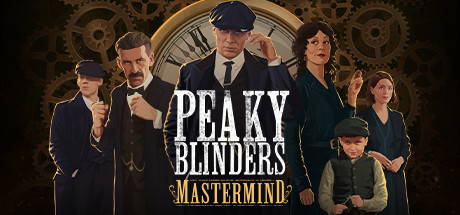
Peaky Blinders: Mastermind is a clever and atmospheric puzzle adventure that transforms the gritty crime drama of the hit television series into a cerebral game of strategy and timing. Developed by FuturLab and published by Curve Games, it takes an unexpected direction by focusing less on violence or dialogue-heavy storytelling and more on precision, coordination, and control. Set before the events of the first season, the story serves as a prequel to the rise of the Shelby family, introducing players to their world at a moment when ambition, loyalty, and cunning begin to define their legacy. Instead of simply adapting the show’s iconic moments, the game reimagines the essence of Peaky Blinders—the manipulation, the planning, the constant dance of power—as a literal gameplay mechanic. The result is a game that’s as much about intellect and timing as it is about crime and chaos.
The core of Peaky Blinders: Mastermind revolves around an innovative time-manipulation system that forms the backbone of every puzzle. Each level unfolds like a meticulously constructed clockwork operation, with players controlling multiple characters—Tommy, Arthur, Polly, Ada, Finn, and John Shelby—each possessing unique abilities. Tommy can persuade and manipulate, Arthur can break down barriers, and Ada can create diversions. The challenge lies in coordinating their actions across time. You can rewind and fast-forward the timeline at will, tweaking each character’s sequence of moves until their efforts align perfectly. It’s a system that demands patience and foresight, forcing players to think like Tommy Shelby himself—always several steps ahead. Success comes from seeing how each decision fits into the larger picture, from distracting guards at just the right second to ensuring that one sibling’s action opens the path for another’s. The satisfaction of watching your plan unfold flawlessly, after several minutes of fine-tuning, delivers a powerful sense of mastery that fits perfectly with the show’s themes of control and manipulation.
The atmosphere of the game captures the dark allure of post–World War I Birmingham with admirable attention to tone and style. The environments—industrial factories, dimly lit alleyways, smoky clubs, and sprawling manors—create a convincing backdrop for the Shelby family’s early operations. FuturLab opts for a slightly stylized, isometric perspective rather than photorealism, which gives the game an artistic flair while maintaining clarity during puzzle-solving. The music, composed in a somber yet rhythmic style, evokes the period’s tension and melancholy, complementing the slower, methodical pace of gameplay. While the game doesn’t feature voice acting or cinematic performances, it manages to convey character through gestures, expressions, and environmental storytelling. The Shelbys are rendered not as replicas of their television counterparts, but as archetypes of their roles—each instantly recognizable in attitude and action, even without spoken dialogue.
In terms of narrative, Peaky Blinders: Mastermind strikes a balance between accessibility and intrigue. The story follows the family as they uncover a conspiracy threatening their rise, giving players a reason to explore the interconnected web of characters and schemes. It’s not a particularly deep or emotional tale, but it provides enough motivation to keep the missions cohesive. The writing focuses on Tommy’s growing authority and his emerging identity as the mastermind of the Peaky Blinders, offering subtle insight into how his calculating nature evolved. Fans of the show will appreciate the nods to familiar dynamics—the tension between brothers, the loyalty to family, the constant push against rival gangs and corrupt officials. For newcomers, the game still works as a self-contained narrative that doesn’t rely heavily on prior knowledge of the series.
Where the game truly excels is in its structure and level design. Each mission unfolds like a self-contained puzzle box, where success depends on careful observation and deliberate planning. Early levels ease players into the mechanics, but later ones demand more complex coordination across multiple timelines. The ability to scrub back and forth through time turns each mistake into a learning opportunity rather than a failure, encouraging experimentation instead of frustration. The system feels intuitive once mastered, and it rewards efficiency with gold, silver, or bronze ratings depending on how effectively you complete objectives. This scoring system adds replay value for perfectionists who want to optimize every move, giving the game a rhythm that’s both meditative and challenging.
Despite its strengths, Peaky Blinders: Mastermind has a few shortcomings that keep it from achieving greatness. The lack of voice acting or more cinematic cutscenes can make the narrative feel detached, especially for fans expecting the intensity of the show’s dialogue and performances. The story itself, while serviceable, lacks the emotional gravity and grit that define the series, and some players may find the pacing too methodical for a game set in a world of crime and rebellion. The controls are generally smooth, but occasional clunkiness in pathfinding or character switching can disrupt the flow of planning. Once you’ve grasped the mechanics, there’s also a sense of repetition that creeps in toward the final chapters, as the core formula doesn’t evolve significantly. Still, the puzzles remain satisfying enough to sustain engagement throughout its concise runtime.
Peaky Blinders: Mastermind is, above all, a thoughtful and unexpected adaptation—one that translates the cunning and precision of its protagonist into gameplay rather than spectacle. It’s less about gunfights and more about foresight, less about brute force and more about orchestration. For players who enjoy tactical thinking, pattern recognition, and problem-solving under pressure, it’s an inventive and rewarding experience. While it may not capture every ounce of the show’s intensity, it manages to embody its spirit in a way that few licensed games achieve. By transforming the Shelby family’s world into a series of intricate, overlapping timelines, FuturLab has created a puzzle game that feels as smart and stylish as the characters that inspired it—a rare case where restraint, rather than excess, brings out the best in the source material.
Rating: 7/10