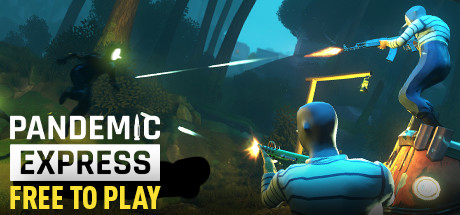
Pandemic Express - Zombie Escape, developed by TALLBOYS in collaboration with tinyBuild and published by tinyBuild, is built around a deceptively simple but highly volatile idea: drop a large group of players into a map, secretly infect one of them, and let panic and suspicion do the rest. What begins as a calm, almost cooperative scavenging phase quickly fractures into chaos as the infection spreads, transforming the match into a desperate race for survival where trust collapses and every encounter becomes a potential threat. The game’s premise alone gives it a strong identity, standing apart from more conventional shooters by leaning heavily into emergent player behavior rather than rigid structure.
The early moments of each match are arguably the most effective, creating a tense atmosphere where players gather supplies, explore abandoned structures, and cautiously observe one another. There’s a quiet unease that builds naturally, as no one knows who will turn first. When the initial infection reveals itself, the pace shifts dramatically—what was once cautious exploration becomes a frantic scramble. Survivors must quickly arm themselves and navigate toward an extraction point, often a moving train, while the infected begin to multiply and coordinate attacks. This transition is where the game shines, capturing the feeling of a sudden outbreak in a way that feels organic rather than scripted.
Mechanically, the contrast between survivors and zombies is the core engine driving the experience. Human players rely on firearms, positioning, and teamwork, often needing to make split-second decisions about whether to help others or prioritize their own escape. Meanwhile, zombies operate on a different rhythm entirely: they are fast, relentless, and expendable, with the ability to respawn and apply constant pressure. As the match progresses, their numbers swell, and what began as isolated encounters turns into overwhelming swarms. This asymmetry creates a natural escalation that culminates in chaotic final moments, especially when survivors make their last stand near the escape vehicle.
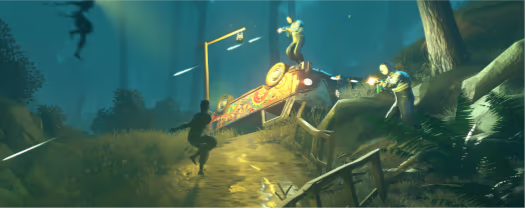
Movement and environmental interaction add another layer of energy to the gameplay. Sliding down hills, vaulting over obstacles, and utilizing vehicles give the game a sense of momentum that keeps matches feeling kinetic and unpredictable. When everything aligns—when survivors coordinate defenses while waves of infected close in—the game delivers genuinely cinematic sequences. There’s a raw, unscripted drama to these moments that few multiplayer titles manage to replicate, largely because they emerge from player interaction rather than pre-designed events.
That said, the experience begins to lose its impact over time due to a lack of meaningful variation. While the core loop is engaging, it doesn’t evolve significantly across multiple sessions. The maps, though spacious, tend to funnel players along similar routes toward the same objectives, and the available weapons and strategies don’t introduce enough diversity to keep long-term play fresh. After several matches, the unpredictability that initially feels exciting starts to give way to familiarity, reducing the sense of discovery.
Technical rough edges further hold the game back. Issues like inconsistent hit detection, occasional bugs, and a general lack of polish can interrupt the flow of play, especially during high-stakes moments. Visually, the game opts for a stylized look that fits its tone but lacks environmental variety, leading to locations that blur together after extended play. The audio design, while serviceable, doesn’t always provide the impactful feedback needed to heighten tension, particularly in combat scenarios where clarity is crucial.
The most significant limitation, however, lies outside the gameplay itself: player population. As a multiplayer-only experience that depends on large lobbies to function as intended, the game struggles when there aren’t enough active participants. Without a steady influx of players, the carefully designed chaos simply can’t materialize, leaving the experience feeling incomplete. This reliance on a strong community ultimately becomes its greatest vulnerability, overshadowing many of its more creative elements.
Even with these shortcomings, there’s something undeniably compelling about what Pandemic Express - Zombie Escape attempts to do. It takes a familiar zombie concept and reframes it into a social experiment driven by paranoia, cooperation, and sudden betrayal. At its best, it produces moments that feel unique to each match—stories shaped entirely by the decisions of the players involved. It’s a bold design that prioritizes unpredictability over structure, and while it doesn’t fully succeed in sustaining long-term engagement, it remains an interesting and memorable attempt at rethinking multiplayer survival.
In the end, the game stands as a strong concept that doesn’t quite reach its full potential. It delivers flashes of brilliance, particularly in its early moments and chaotic finales, but struggles with repetition, technical issues, and the practical challenges of maintaining an active player base. For those able to experience it in a populated setting, it offers a glimpse of something genuinely innovative, even if that promise ultimately feels only partially realized.
Rating: 6/10