NeoCube developed by Vyacheslav Ozolnieks and Georgy Studenikin and published by Madgobbler is a compact puzzle experience built around a single central mechanic: manipulating and navigating a cube through a series of self-contained test chambers. Framed within a minimalist sci-fi setting, the game places players inside abstract environments that resemble experimental facilities, where logic and spatial awareness are the primary tools for progression.
The structure of the game is straightforward. It presents a sequence of discrete levels, each functioning as an independent puzzle room. The objective in every chamber is clear, but the method of achieving it often requires experimentation and careful observation. The cube itself behaves according to specific physical rules, and understanding these behaviors becomes the key to solving increasingly complex challenges. Early levels serve as tutorials, gradually introducing mechanics without overwhelming the player, while later chambers demand more deliberate planning and precise execution.
Mechanically, the game keeps its systems simple and focused. Controls are intuitive, minimizing barriers to entry and allowing players to concentrate entirely on puzzle-solving. There are no combat elements, narrative cutscenes, or branching paths—only a steady progression of logic-based obstacles. This simplicity ensures accessibility but also defines the experience’s limitations. The absence of additional mechanics means that variation must come solely from environmental design and incremental complexity.
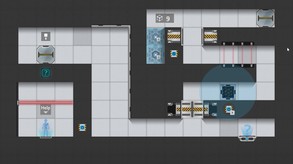
Visually, the game adopts a clean and functional aesthetic. Environments are rendered in a minimalist style with clear geometric shapes and subdued color palettes. The design prioritizes clarity, ensuring that interactive elements stand out within each chamber. While the visual presentation lacks elaborate detail or artistic flourish, it supports the puzzle-focused gameplay effectively by eliminating unnecessary distractions.
The game’s pacing is deliberate. Each level encourages patience and trial-and-error learning. Some puzzles can be solved quickly once their underlying logic is understood, while others may require multiple attempts and reconsideration of assumptions. This steady difficulty curve provides moments of satisfaction when solutions are discovered, particularly in later stages where mechanics are layered in more intricate ways.
Audio design remains subtle, complementing the sterile sci-fi atmosphere without dominating the experience. Ambient sound effects and understated background tones reinforce the sense of being inside a controlled testing environment. The restrained soundscape aligns with the game’s minimalist philosophy, maintaining focus on logic rather than sensory immersion.
Replay value is limited primarily to personal challenge and achievement completion. Once puzzles are solved, there is little incentive to revisit earlier chambers unless pursuing faster completion times or mastery. The linear progression and absence of alternate solutions or branching designs mean that the experience is largely finite once completed.
Ultimately, the game stands as a modest but focused puzzle title. Its strengths lie in its clear mechanics, accessible design, and structured difficulty progression. However, its simplicity and limited scope may not satisfy players seeking deep innovation or extended campaigns. For those who appreciate compact, logic-driven experiences centered on spatial reasoning, it offers a concise and methodical journey through a series of cerebral challenges.
Rating: 5/10