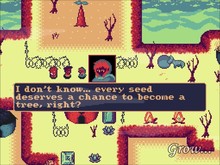
Nadia was Here is a gorgeous pixel RPG that is inspired by 8 and 16 bit classics. Featuring a groundbreaking combat system and a deep, charming story about the value of life, Nadia was Here lets you play an oldschool RPG in a brand new way!
Modeled estimate, not a reported figure. How we estimate →
Media
About
Stats
All-time low is the lowest price we've recorded for this game since we started tracking it.
Languages: English
Engagement
Reviews
Themes across 42 recent reviews and how positive each mention is. A keyword signal, not full sentiment analysis.
Reviews
The game is absolutely brilliant. I wholeheartily recommend it, especially to anyone who likes puzzles or pixelated RPGs. The gameworld is divided into sections, each of which consists of many rooms, full of clever puzzles. Over the course of the game, you unlock various new methods of interacting with the world, that allows you to reach previously unreachable places. The puzzles themselves are usually not too hard, they are well designed and some of them require quite some thinking, but it's never frustrating. Lots of them are optional - they offer additional rewards, but are not necessery to progress in the game. This is the core gameplay loop. The other gameplay element is the battle system. It's quite innovative thing really, I prefer it to all the battles we are used to from RGP Maker games. Here the battles are real time with pause, based on 3-lanes system. The goalis to switch your heroes positioning and their equipment (during battle) so they kill enemy efficiently and aren't hit hard themselves. It's quite fun, but can be sometimes a little frustrating. You can check the battle mechanics in free demo available here on Steam. The art is beatiful and very original in style, just check the screenshots. Music is great as well. The story is quite interesting, the dialogs are short and good enough, with some humour. The mechanics of finding flowers gives you motivation to go to the previous areas (as some flowers cannot be accessed during the first-run through the arena, as you don't have the powers needed to reach them) - and it's actually quite fun to figure out how to reach the flowers. I just finished the game and only managed to find 42 or something, while there are 50, according to an achievement. And you are not just doing that for the achievement, there are rewards in game as well. The game lenght - while the devs said the game takes about 10 hours, I think that is only possible if you know precisely what exactly to do and you don't try to get everything. I finished the game with about 21 hours on the counter in game. Quite some of that was when I was stuck and figuring out how to solve some puzzles - but as I mentioned, it was very fun and not frustrating. So, overall, I really recommend it. The author did a really great job..
Related
Related
Trends
Modeled estimate over time.
Hours played at review time, across 42 reviews with recorded playtime.
positive critical· bar length = how often the theme comes up
My playtime is fairly low and, full disclosure, I requested a refund. The game doesn't seem *bad*, don't get me wrong. The pixel art is pretty decent, but the perspective on the game world layout was just.. strange. The way doors and walls and such are rendered makes it hard to get a real sense for it all. They seem to be kinda stuck between NES/SNES, rather than really nailing something down as far as what they were going for. The characters are so low resolution pixel-wise that they're kinda distractingly non-distinct. The sound effects were sometimes fine and sometimes kinda jarring and harsh, in a way that pulled me from the game. In particular, the end-of-battle sounds for gold/xp adding up were oddly kinda harsh, and the sound that played during NPC text was kinda more annoying than anything else. Maybe it's a bit loud or a bit too sharp? I'm not sure, but it kinda bugged me a bit! A bigger personal, but your-mileage-may-vary complaint, is that you can't use a dpad.. Even though it's a cardinal-direction grid-based movement game, so you may find yourself often going up or down when you try to go left or right because joysticks just work that way, and bumping into things you dont' mean to. The combat is unique and novel, but kinda just seemed needlessly fiddly rather than especially drawing me in. If it were a bit cheaper I might hang onto it and play it aynways, but for $12 I'll refund it and maybe look again later at a discount and/or when some control improvements or other changes have been made. Speaking of which - no control customizations exist, having a controller plugged in locks out mouse/keyboard *entirely*, too. Ultimately I think folks who are interested in this game should try the demo with the combat - if it speaks to you, then grab it, if it doens't, then it doesn't look like there's a lot else that really goes too far outside the box here, as far as I can tell from my (relatively short) playtime, other reviews, etc. The dialog and story didn't exactly draw me in, but maybe it needed some more playtime for that.. but even still, the voice of the writing based on the initial characters and such didn't lead me to believe that'd be the case.
At it's heart, Nadia Was Here is a puzzle game. The description might say it's an RPG, but if you don't like lots and lots of puzzles, then thanks for your time, but this game is not for you. For everyone else, let me tell you about this awesome undiscovered gem. Nadia Was Here has two major gameplay features: the dungeons and the combat, which are both puzzle based, in my opinion. First up, combat. Combat works like a typical Final Fantasy Active Time Battle system in that each character has a gauge and it fills up. Once it's filled, the character takes an action. The difference with NWH is that there is no pause once the gauge is filled for you to select your action. All the characters will continuously do whatever action is selected until you switch them. Instead, when you want to switch between actions, you just select the character, select the new action (which pauses the game), and that's it. The character will now continuously do the new action. Another part of combat is lanes. You have 3 characters arranged in a vertical line. Each character faces an enemy arranged in a similar vertical line. Each character can only hit the enemy in front of them. However, you can switch you characters around at any time. So if your physical attacker gets paired with a physical immune enemy, just swap him with the mage. You can also see the enemy's attack gauge, so when you combine the two, you get some neat puzzles to solve. Do you want to steal something with your squishy thief, but the enemy is a strong physical attacker and will ice her in one hit? Wait for her attack gauge to fill up, switch her in for the hit, and then switch her with your tank so he can take the enemy hit. Let's talk about the characters, because they're all unique. First up is Nadia. She's a thief, so she steals stuff. That's it about her, right? Nope. She steals enemy weapons, which she personally adds to her arsenal. So, eventually you'll stockpile a huge pile of weapons (really, just special skills) that she'll use on the enemy. Need to poison an enemy? Use the fang. Health is constantly low? Use the claw which does more damage depending on how low your health is. Next up is Hogan, your physical tank. His specialty is shields. Some of them will reduce physical or magical damage, but others will increase his attack or inflict status ailments when he attacks. Last is Tereshan, the mage. He's actually a newbie mage, so you'll have to learn them from enemies by having Tereshan complete his study action while an enemy is casting the spell you want to learn. He'll be your main magic and status damage dealer, along with your healer. Speaking of healing, any items you need to use don't take an action for the character. They're done real-time, by you. Do you want to chuck 5 small potions on your characters in 5 seconds? You can do that. Dump a bunch of charms (magical damage) on one enemy before their turn? Go for it! If you're feeling overwhelmed by the battle system, don't worry. You can always pause the game at anytime to see what's going on, or set the battle speed to 50% if it's going by too fast. Aside from getting weapons/skills/shields/magic/etc, from the enemy, the only other piece of equipment to worry about are amulets that you'll find around the world. Each character has 3 slots for amulets, and an amulet can be upgrade 3 times for better and better effects. You can get more HP, a better steal chance, or just more money and dust (currency for upgrading amulets) from battle. That's it for accessories. No armor or weapons or whatnot to worry about. In addition, there are no random battles. Either you'll see the enemies in the dungeon (and the only respawn in one dungeon in the game), or when you move to a new area for the first time, the game will pop up with a window saying that you'll have to fight X battles in a row. Once you do that, that's it. If you want to fight some more, you'll have to find some new areas on the map or go in the arena. That's a lot of words for the battle system, but that's a major draw to the game for me. The battle system is amazing. Every battle is fun and exciting, and once the game starts ramping up the enemies, they do really become a puzzle to be solved. Is an enemy kicking your teeth in? Then you better change your strategy because there is no grinding and no levels. You might worry about the "no levels" bit, but the difficulty curve is so good that [i]I didn't realize there weren't any character levels until near the end of the game[/i]. In this game, I'm constantly looking forward to new enemy encounters because of how fun they are. What new weapon and/or magic will I get from this enemy? What kind of new strategy do I need to defeat this group? The second major draw from NWH is the dungeon puzzles. In each dungeon there are multiple puzzles to solve before you can progress, eventually you'll get items which are used to solve more puzzles in dungeons. And then you'll get more items that will combine with your other items in puzzles that need both items to progress. The first item you get is the Earth Flute, which is a bit boring. You use it to grow plants. I didn't find many interesting puzzles using it, but the second item you get is the Fire Bongos, which let you set the space one square in front of you on fire, which is used for burning plants that block your way. Notice the limitation of one square in front of you, and not directly in front of you. There are a lot of puzzles that take into account the fact that you can't just walk up to a plant and torch it. The other two items you get are equally as awesome and interesting. Because there are no random encounters, the puzzles become quite elaborate, but that's OK because you're never interrupted in the middle of your puzzle. The game also has a couple of quality of life improvements for an RPG. While there are save points that refill your HP and remove any status effects, the game also saves on every screen, so it's easy to put the game down for the night when you're in the middle of a dungeon. To talk to people or search objects, you just need to bump into them, no mashing X required. There are also hidden items everywhere, so it's fun to walk around and bump into things and see what you get. You can also switch characters on the fly, and NPCs will sometimes say different things depending on who they're talking to. The story has an interesting hook, once it gets going, and the characters are pretty interesting, but they could be fleshed out a bit more. If you're playing this game, it's a lot more for the gameplay and less the story. It's been a while since a game hooked me like this, especially a psudo-RPG. I've got 21 hours so far, and I'm taking on the side quests because I don't want the game to end. I'm planning on getting all the achievements too (they're pretty reasonable). I love the chiptune music, and something about that weird colour pallet just draws me in. This game definitely needs more love, so if you want to solve puzzles in dungeons with a cool battle system, go pick this up! There's also a battle demo, so you can check out the battle system if you're interested! Go for it!
Вот еë карма… Я ещë борюсь за свою карму, а у неë карма, она уже всë — в раю. Она — ангел.
*NOTE: This review follows a full playthrough of the beta and an almost-complete playthrough of a near finished build When I first saw this game on Kickstarter, I found myself getting pretty damn excited, even though I never was too big on classic RPG's such as Golden Sun or Final Fantasy. I saw the appeal, but it just never was for me. I liked the genre, but if I was given a SNES, my first pick would probably be one of the classic FE games or Kirby Super Star, simply because RPG's seem too have way too many cliches and low points that I just can't get over. Nadia Was Here manages to take an existing genre and put a spin on it in a way that completely reinvents the genre itself. Nadia Was Here tells the story of three people who share one thing right off the bat: they're troubled. Nadia feels misplaced and worthless, Tereshan judges himself beyond reason, and Hogan feels forgotten and unloved. Each of the characters recieve equal recognition throughout the story and builds them incredibly. I do have gripes with the story though, which I'll get to soon, but for the most part I felt the story did it's job and the writing proved to be entertaining. Probably the most unique thing about Nadia Was Here is it's battle system. Set on three rows, Tereshan, Nadia, and Hogan must fight off enemies by moving around in their lanes to strategically take out enemies. Each character manages to feel completely different with playstyles and strategies. Nadia can steal weapons and loot from enemies to further expand her arsenal and potentially give a game-changing health potion to your team, Tereshan can study enemy attacks to give him a wide array of attacks (both supportive and offensive), and Hogan utilizes a shield that provides stat boosts to the team. You'll find yourself moving around your team constantly to avoid enemy attacks while also focusing on damaging the enemy. The system never fails to keep your mind active while challenging your strategic ability in battles. In addition to the unique battle system, Nadia Was Here also features a unique progression system. Instead of leveling up, Nadia steals weapons from the enemy and Tereshan directly copies enemy attacks which carry over between battles. Nadia will find a claw that gets stronger the lower her health is, a knife that gets more accurate with every hit, and, most famously, a stick that always does exactly 3 damage. Tereshan on the other hand will inevitably have a much more expansive loadout, as almost all enemy attacks can be copied for him to use throughout battles. From health draining attacks to status cleansing spells, Tereshan will prove to be the most versatile party member, either serving as a dedicated healer or a lethal damage dealer. Despite Tereshan and Nadia's versatility, Hogan is rather lackluster by comparison, with his main draw is the ability to use shields that provide buffs to your team. With only a handful of shields and only one or two truly useful ones, Hogan will end up feeling rather unchanged throughout your adventure. Not to say he's bad, just simply more boring in comparison. The world of Amytah boasts a handful of towns and multiple dungeons. Including a lava-filled temple, a tree surrounded by water, and a library haunted by a librarian wanted her 100-year overdue book back, the variety here is certainly appriciated. However, the towns are rarely a major part of the game, with most only needing a single visit and then never requires a single visit after. While dissapointing, I found myself going back to previous towns simply to view them again or reread NPC dialogue. I would mainly return to the Hot Springs Inn, mainly to hear the lovely theme there. The soundtrack, while enjoyable, isn't exactly something to talk about. I only heard most of the songs for a brief time during gameplay (as I do not have access to the soundtrack), but there are a handful of songs I certainly enjoyed, such as the previously mentioned Hot Springs Inn theme. At the end of the day, Nadia Was Here manages to break multiple cliches the genre suffers from and adds a completely fresh and memorable experience. If you like classic RPGs and are dying to play something new, I highly reccomend this to you. Hell, if you have a passing interest in the genre this is something you should give a go. It's not about to revolutionize the industry, but it certainly entertained me during my playthroughs.
Understandably, I did not play this game for too long, so I cannot expand upon a lot of details for the game. Hence, this review is not quite an expansive one to judge everything. In all honesty, the style of the game turned me away really quickly, which is somewhat ironic. But I will explain why. I had some argument with myself that I wanted to play the game and try to enjoy it, but I found myself feeling like I just wouldn't enjoy it given by some clear signs right away. I bought the game over one of the trailers due to the music and the way battles looked, among some other details. I thought the artistic style was weird, even for something trying to do NES/SNES (with some mix of Atari-like colors) from the pictures... But that didn't bother me too much when I first looked at the game. So my mistake in purchase wasn't over the looks at all. It was more for the audio and gameplay. I knew from the beginning that the game would have some retro sound effects; but the trailers had some interesting, mixed-up music, so I was hoping for it to be a bit different. Instead, I do not think much of the music that I was hearing was like that in the trailers (which play 3 different songs). That sort of disappointed me at first. But even worse, a lot of the basic sound effects are really annoying and are even more exaggerated than they were on retro systems. The static sound when you switch screens particularly kills my ears, and I cannot tell if it is just the way my speakers are handling it or if the game intentionally plays it that way. I have played video games my whole life, and retro systems [i]never[/i] made me squirm when I heard certain sound effects. This game did, however. Then when it comes to the gameplay, there are a few small details plus a bigger one. I do not like the way the control system works, nor do I like how you navigate by repeatedly walking into objects and people to interact with them. That definitely felt odd for me. Maybe I played games decades ago that did that, but I can't quite remember. Besides that, the battle system made me feel like I would like it less than I saw in the trailers. It showed that it can be interesting at first, because you can swap around and move characters in front of certain enemies (or rather avoid other ones). But even with that, the battles seemed like they went in slow-motion. I had the 100% speed setting on, and even noticed a button that seemed to slow battles down or keep them at "normal" pace. Even at normal pace, it seemed like it would take forever for turns to occur, and I felt like I would spend large amounts of time waiting in battle. I am sure battles get more complicated, but I usually do not find many turn-based RPGs complex enough to absolve really slow timers. Because of the above reasons, I figured that I wouldn't continue with the game.
Nadia was Here has a fun, active battle system, and more puzzles than you can shake a stick at. Nadia's battles are fun from beginning to end. You control three characters, each with their own specialty, which together make up and odd but satisfying party. You have a defender who spends a lot of time jumping in front of enemy hits while trying not to disrupt your party formation too much, a thief who steals weapons she can then use in combat, and a mage who learns spells from other casters (and is otherwise helping do damage or heal). It's a game without excess battles, and it rewards you for doing more than just winning - stealing/learning is your main way of improving your characters, so you might have to spend some time figuring out how to goad a boss into doing an ability at exactly the right time, so you can learn it yourself, then scrabbling to win the battle. The combat system is definitely the reason to get this game. You spend most of the rest of your time doing puzzles. Your puzzle-solving isn't interrupted by combat very often, and you earn more tools to solve the puzzles as you go through the game, which I'm usually a fan of... But you do spend a lot of time sitting in front of puzzles, more than I expected going into the game, and a few of the puzzles feel quite similar to each other. Be ready for each area to take a decent chunk of time. You should definitely play this game if you want to try out a more active RPG battle system, and/or if you like puzzles in your RPGs.
I normally prefer making more in-depth reviews and only doing so after at least beating a game, but Nadia Was Here is leaving the Steam store on February 1st, 2024 (tomorrow as of posting this review). As such, I'm putting up a quick blurb to promote the game for anyone who might be interested before it's gone for good. I'm around three hours in so far. I really like the battle system, it's active without feeling stressful. You can easily pause when needed to think out moves, but you also have to be alert to move characters around for dodging/reacting to enemies. It's a cool take on classic turn-based mechanics. I'm enjoying the characters so far, there's some good humor and the game makes use of each one having their own niche along with having some different interactions with NPCs. Plot seems fairly standard but that's fine by me since the characters and dialogue are entertaining. If you're in the market for an old-school-inspired RPG with an interesting battle system and an enjoyable experience overall, I can say that I've been getting my money's worth so far. I'd recommend getting it before it goes off the store unless you're certain it's a genre you're not going to engage in.
If this came out during the 8/16 bits era it would probably be a classic by now. I haven't come across a JRPG that made me feel like I was playing on my SNES again like this one did in a long, long time. + The battle system is very original despite being pretty simple. You have three characters (a thief, a warrior and a mage) opposing 1 to 3 enemies, and you have to switch their positions vertically to maximize their efficiency and minimize damage. Since all actions have a casting time (it's more or less similar to Final Fantasy IV-IX's ATB, except the actions loop by default so you don't have to confirm them all the time), you will frequently have to do things like moving the warrior to tank a hit that would otherwise one-shot the mage just before the enemy acts, or rapidly switching characters to the same position to kill an enemy before it can heal to max or unleash an attack that would cripple your party. This means you'll be moving your characters around more than you will be switching actions. I'm pretty terrible at describing how this system feels so different and fresh for the jaded JRPG player that I am, but really, it's great. Most battles feel more like puzzles than actual battles, since you need to do them optimally or face a game over as soon as one of your characters falls. + Speaking of puzzles, this is the other great thing about this game. The dungeons are full of them, and they're kinda similar to those found in the 2D Zeldas. Also, they're quite hard (I [i]really[/i] wanted to burn the final dungeon to the ground when I got stuck on those gigantic one-room puzzles). + While it's not visually impressive (it's mostly tones of red and blue, as you can see in the screenshots), its atmosphere is very similar to those 90s JRPG it tries to emulate. The story is interesting without being complicated, the characters have just enough backstory and quirks to stop them from being mere functions, and the rest of the world is made of those walking street signs known as NPCs. Nothing particularly new here, it's minimalist, but it works. - The UI can be clunky at times, particularly when you want to use an item in battle (I suggest pausing the game when you want to do so, unless you're the kind who likes getting an extra dose of that debuff you just tried to heal). That menu opens with RT for some reason. I never understood the fascination modern gaming holds for that button. - There are a few annoying design flaws here and there (like the lack of mobility during a lot of puzzles that would benefit from it, but end up cluttered by random impassable blocks, or the Mines boss who basically only has instant kill attacks and who I had to fight like 10 times before finally figuring the trick). 8/10 One of the few retro-inspired JRPGs that actually brings something new to the genre instead of just copying Dragon Quest and Final Fantasy. Get this if you like what the previous sentence described and are not averse to intricate puzzles.
Sometimes no matter what we do in life the result will not change. And sometimes the most pointless things may may a change. What this has to with [b]Nadia was here [/b] is something you can only find out by playing the game. In its core [b]Nadia was here [/b] is a puzzle game. This is something which can be seen all over the game. In the areas, in the instruments it provides you, in the amulets you can combine to create synergy effects and in the fights. Often it is the game's greatest strength and in some cases also its weakness. But let's go step by step. [b]Nadia was here [/b] story is not overly complicated. It gives some nice food for thought but especially in the first half of the game it is just happening as a side note. It starts with a short sequence of Nadia as a child somehow lost in a village and then switches over to Hogan starting his search for his lost shield. The third in the group, joining a bit later, is Tereshan searching for a specific item because he has an unpleasant foreboding. The puzzles are mostly solved with the items you gater over the course of the game. Every few areas you get something new which makes up for some new puzzles. While this gives some diversity I often had the feeling that the area puzzles overstayed their welcome a bit. I wished they would have been a bit fewer and ended earlier. At the end of each area they felt tedious to me and I was glad if I was finally done. It may be different for you though. An enjoyable exception to this are the flower puzzles. Early to midgame you get a camera to make fotos of specific flowers which you can trade in for access to some special items (like one of the strongest shield and an item for the final sidequest). To reach these flowers you have to solve puzzles again. However, as they are bonus they are not solely tied to the actual area item but a combination of different items which makes up for smarter puzzles. However, this also means backtracking as you often don't yet have the necessary item at that point in the game. While backtracking often is easier due to some permanently changed map elements there are also a few places with this not being the case. Bioluminescent Caves for example are a pain to be backtracked. The secret star of the game is the fighting system though. After the intro section you have your three characters: Nadia, the Thief; Hogan, the Shieldbearer and Tereshan, the Mage. In contrast to typical RPG's you don't level by fighting. Winning fights is mainly a question of strategy and especially later fights ask for very specific strategies to be used and can as such be considered a puzzle you have to figure it out. Each character has hereby a different mean: [list] [*] Nadia can use different weapons each with an unique ability. However, to use them she has to steal them from enemies before. [*] Tereshan can use spells which he equally has to copy from enemies before. [*] And Hogan can use different shields which can be bought at certain shops. [/list] This is rounded up by the amulet system of which each character can wear a total of three to complement abilities and create synergies. Amulets can also be upgraded by using Dust which is dropped by enemies. As enemies are "limited" (each enemy can only be fought once) you get access to an arena mid-game where you can gather gold and dust and also learn spells/steal weapons you missed the first time. There is also a bit of bonus stuff. I've mentioned already the arena and the flowers. Add to this two optionable bonus areas and you have quite a bit of content in addition to the main quest. And the final sidequest has some of the most interesting fights in the game. Music was neither overly spectacular nor really annoying so I would say it was fitting enough. The graphic however is quite special and the first two hours I needed to get used to. So if you have trouble with just keep playing. Because afterwards I was impressed how natural and fitting it started looking for me. For the achievement hunters: Nearly every achievement can be gathered in own pace (so don't worry about the game saving automatically) and after beating the final boss you can play "post-game" (although it is technically before final boss fight again). The only achievement which can be completely missed is the "Play whole game in 100 % fighting speed modus" so be sure to check this before starting the game and never change it back. An additional reason for my recommendation is the developer which has been quite useful and talkative on different subjectives about the game. As always, I think this is something which should be honoured because it happens rarely enough (and maybe he will create a workaround for my achievement problem :P). So support him and buy the game and help the game not getting part of a bundle. Also as personal side note, I really like the epilogue so make sure to play till the end ^^ PS: If you have any questions feel free to ask and I will try to get back to them as fast as possible.
Momentum
Pace estimated from the game's recent review growth (our daily snapshots) at its own sales-per-review ratio — a momentum signal, not booked sales.
Audience
Estimated from the language of this game's reviews — a proxy for where players are, not official Steam demographics.