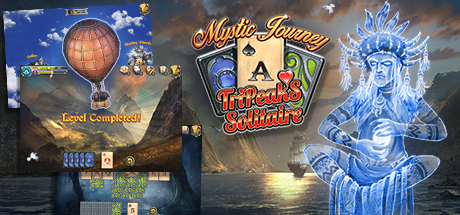
Mystic Journey: Tri Peaks Solitaire, developed and published by FIVE-BN GAMES, is a polished and content-rich take on the classic Tri Peaks formula, blending familiar card mechanics with a light narrative framework and a progression system designed to keep players moving forward. At its core, it remains true to the traditional rules of Tri Peaks solitaire—removing cards that are one value higher or lower than the current draw—but it builds on that simplicity with layered presentation, level design, and a steady sense of progression that transforms the experience into something closer to a casual adventure.
The gameplay loop is immediately accessible, requiring little explanation even for players who are new to solitaire variants. Each level presents a tableau of overlapping cards arranged in distinct formations, and the objective is to clear them using careful sequencing and efficient use of the deck. While the mechanics are straightforward, the game introduces a variety of level-specific twists that gradually increase complexity. Obstacles such as locked cards, blocked paths, and special modifiers force players to think more strategically about how they approach each layout, preventing the experience from becoming entirely automatic.
Progression is structured around a large series of handcrafted levels, each designed to feel slightly different from the last. This structure gives the game a sense of momentum, as players move from one stage to another while unlocking new areas and visual themes. Power-ups and boosters add another layer to the experience, providing tools that can help overcome difficult situations or extend a run. These elements strike a balance between accessibility and challenge, allowing casual players to advance while still offering opportunities for more careful, optimized play.
The narrative component, while not central, adds a sense of cohesion to the journey. Players follow a character who finds herself in a mysterious and shifting environment, moving through locations that feel both physical and symbolic. The story unfolds in small fragments between levels, offering just enough context to give the experience direction without overshadowing the gameplay. It functions more as a thematic backdrop than a driving force, but it helps elevate the game beyond a purely abstract card experience.
Visually, the game is one of the more refined entries in its genre. The environments are colorful and varied, with each new area introducing a different aesthetic that keeps the presentation feeling fresh. The art style leans toward a soft, almost dreamlike quality, which complements the game’s relaxed pacing. The interface is clean and intuitive, ensuring that players can focus on the cards without distraction, while the music and sound design reinforce the calm, low-pressure atmosphere.
Despite these strengths, the game’s free-to-play structure has a noticeable impact on the overall experience. Progression is tied to an energy system that limits how many attempts can be made in a given session, creating interruptions that can break immersion. While this system encourages shorter play sessions, it can also feel restrictive, particularly when players are engaged and want to continue. Additionally, the use of boosters—often tied to premium currency—introduces a layer of monetization that can influence how certain levels are approached.
Another challenge lies in the balance between strategy and randomness. While skilled play is rewarded, there are moments where success depends heavily on the order of card draws. Some levels can feel unwinnable without favorable conditions or the use of additional tools, which can lead to frustration over time. This reliance on chance is inherent to the genre, but it is more noticeable here due to the structured level progression and difficulty spikes.
Over extended play, repetition becomes a factor. Although the game introduces new layouts and occasional variations, the core mechanic remains unchanged, and the sense of novelty can diminish. The narrative, while pleasant, does not evolve significantly enough to offset this repetition, leaving the gameplay loop to carry most of the experience.
Even with these limitations, Mystic Journey: Tri Peaks Solitaire succeeds in delivering a cohesive and engaging casual experience. It understands its audience and provides a steady, approachable rhythm that works well in short sessions. The combination of polished presentation, structured progression, and simple mechanics makes it easy to return to, even if it does not offer deep long-term variety.
In the end, Mystic Journey is a well-crafted and visually appealing take on Tri Peaks solitaire that adds just enough structure and personality to stand out within its genre. It is best enjoyed as a relaxing, low-commitment experience rather than a deeply strategic or endlessly varied one, offering consistent enjoyment within the boundaries of its design.
Rating: 6/10