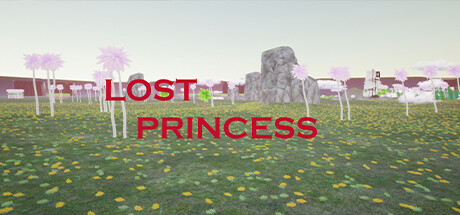
Lost Princess from Tero Lunkka and Valkeala Software is a very stripped-down first-person exploration game that centers almost entirely on wandering through a quiet environment and collecting scattered objects. Framed around the simple objective of locating a missing princess, the experience quickly reveals itself to be less about narrative discovery and more about methodical item hunting. It falls into the category of low-intensity walking simulators, but even within that space it leans further toward minimalism, offering a gameplay loop that is easy to understand yet difficult to find deeply engaging over extended periods.
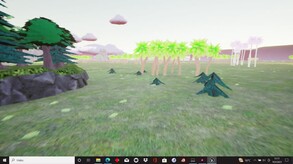
From the outset, the game places the player in a modest open area that gradually expands into forests, ruins, and castle-like locations. There is no structured guidance beyond the implied goal, and progression is tied to picking up specific items placed throughout the world. These collectibles serve as both checkpoints and the primary motivation to keep moving forward. However, the act of finding them rarely evolves beyond simple observation. Items are typically positioned in visible or lightly concealed spots, meaning that exploration becomes more about thorough scanning than problem-solving. This creates a steady but repetitive rhythm where the player walks, looks around, collects, and repeats without encountering meaningful variation.
The open-world aspect suggests freedom, but in practice the environments feel more like loosely connected zones than a cohesive world. While there is some visual distinction between areas, they tend to lack detail and interactivity, giving the impression of large spaces with very little happening within them. There are no characters to meet, no dynamic events, and no environmental storytelling that adds context to the search for the princess. As a result, the journey feels detached from its premise. The goal exists, but the world does little to reinforce why it matters or what is at stake.
Visually, Lost Princess is extremely basic. The environments are constructed with simple geometry and textures, and there is little in the way of lighting or artistic direction to elevate the presentation. The world is functional rather than expressive, serving primarily as a backdrop for the collectible hunt. While this level of simplicity can sometimes create a certain charm in indie projects, here it contributes to a sense of emptiness. The lack of animation or visual feedback further reduces the feeling of immersion, making interactions feel static and mechanical.
Audio design follows a similarly minimal approach. There is little emphasis on music or ambient sound to shape the atmosphere, which results in a quiet, almost sterile experience. This absence of audio depth reinforces the game’s low-energy tone but also removes an important layer of engagement. Without sound to guide or enhance the experience, exploration can feel monotonous, especially during longer play sessions.
One of the defining traits of the game is its accessibility. There are no complex controls, no difficulty spikes, and no pressure placed on the player. It is possible to approach the game at a relaxed pace, making it suitable for those who prefer undemanding experiences. However, this accessibility comes at the cost of depth. There are no systems to master, no challenges to overcome, and no meaningful decisions to make. Once the core loop is understood, the rest of the game offers little in the way of surprise or development.
Replay value is limited, as the primary activity of collecting items does not change between playthroughs. After completing the objective and finding all necessary items, there is little reason to revisit the game unless one is interested in re-experiencing the same process. The overall length is short, which helps prevent the repetition from becoming overly exhausting, but it also means the experience ends before it has a chance to build toward anything more substantial.
Taken as a whole, Lost Princess is a very modest project that delivers a simple and undemanding exploration experience but struggles to offer anything beyond its basic premise. It is consistent with the style often associated with its developer, focusing on accessibility and straightforward design rather than depth or innovation. For players looking for a quiet, low-effort distraction, it may provide a brief sense of relaxation. For those seeking immersion, narrative engagement, or mechanical variety, it is likely to feel underwhelming.
Rating: 5/10