Lazerbait is a virtual reality strategy title created by Taylor Stapleton that focuses on large-scale fleet warfare while stripping real-time strategy gameplay down to its most essential ideas. Rather than building an experience around extensive economic systems or complicated unit management, the game centers itself around territorial expansion, battlefield awareness, and rapid decision-making. The result is a streamlined strategy experience that remains easy to understand while still offering enough tactical depth to keep players invested over multiple sessions.
Set across minimalist space battlefields, Lazerbait places players in command of planetary expansion efforts where victory depends on controlling territory and overwhelming rival forces. Each captured planet continuously strengthens military production, creating a cycle where expansion directly fuels future opportunities. Success comes from balancing offensive momentum with defensive awareness while constantly evaluating where resources and fleets should be deployed.
The gameplay structure embraces simplicity immediately. Instead of overwhelming players with complex menus or dozens of resource types, the game introduces straightforward mechanics that become understandable within minutes. Fleets move between planets, planets generate military strength, and battlefield control determines long-term survival. That simplicity creates accessibility without eliminating strategic thinking.
Managing expansion becomes the heart of the experience. Players constantly face decisions regarding whether to push aggressively toward neutral territories or reinforce vulnerable positions before opponents strike. Expanding too quickly can create defensive weaknesses that skilled opponents exploit. Playing too cautiously risks surrendering valuable production opportunities. The balance between growth and stability becomes increasingly important as matches evolve.
What helps Lazerbait remain engaging is how naturally strategic layers emerge from limited mechanics. Initial matches may appear simple, but longer play sessions reveal how positioning, timing, and territory prioritization influence success significantly. Understanding when to launch attacks and when to consolidate strength becomes increasingly important. Strong strategic choices consistently outperform reckless expansion.
Artificial intelligence competitors strengthen replayability effectively. Multiple opponents competing simultaneously create shifting battlefield situations where priorities constantly change. A position that feels secure one moment can suddenly become vulnerable as enemy forces redirect attention elsewhere. These changing conditions encourage flexibility rather than rigid strategies.
Procedural map generation also contributes significantly to long-term variety. Planet placements differ between sessions, requiring players to adjust expansion plans and battlefield approaches continually. Strong habits remain valuable, but each match introduces enough variation to prevent encounters from becoming predictable. The changing layouts create opportunities for experimentation while helping maintain replay value.
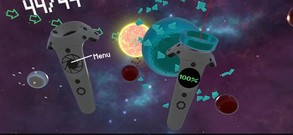
One of the game's most distinctive strengths comes through its virtual reality implementation. Viewing battles from an elevated perspective creates a unique sense of command that traditional strategy games often struggle to replicate. Looking down across active battlefields while directing fleets around planetary systems reinforces immersion in ways that feel particularly effective inside VR spaces.
Motion controls integrate naturally into the overall design. Issuing commands through physical interaction creates a more direct relationship with battlefield management. Instead of relying entirely on traditional interfaces, players physically engage with the battlefield itself. The implementation feels designed around virtual reality rather than simply adapted to support it.
Visually, Lazerbait embraces a clean presentation style that prioritizes readability over visual excess. Planetary systems remain easy to understand even as fleet numbers increase substantially. The minimalist aesthetic supports gameplay effectively by ensuring battlefield information remains clear during larger engagements.
Audio design reinforces the science-fiction atmosphere without overwhelming concentration. Sound effects provide satisfying battlefield feedback while remaining subtle enough to support longer strategic sessions. The soundtrack maintains futuristic energy without distracting players from tactical decision-making.
One area where some strategy veterans may feel limitations comes from the intentionally focused design philosophy. Players looking for technology trees, large-scale resource economies, or highly layered management systems may find the experience more streamlined than expected. Lazerbait avoids complexity deliberately, focusing instead on accessibility and tactical momentum.
That focus ultimately becomes one of the game's greatest advantages. Taylor Stapleton created a strategy experience that remains approachable without sacrificing meaningful decision-making. New players can understand its fundamentals quickly while experienced strategy fans still find opportunities to improve execution and battlefield awareness.
The pacing also deserves recognition. Matches move efficiently without unnecessary downtime, creating satisfying momentum throughout gameplay sessions. Battles rarely become slow or stagnant because territorial control constantly shifts strategic priorities. Every decision carries weight, reinforcing engagement from beginning to end.
Lazerbait succeeds because it understands restraint. Instead of overwhelming players with features, it focuses on refining a smaller collection of mechanics until they work together smoothly. The combination of accessible systems, replayable battlefield design, and strong VR integration creates a strategy experience that feels unique despite its simplicity.
Players interested in virtual reality strategy experiences, space warfare, or streamlined tactical games built around territorial expansion and quick decision-making will likely appreciate what Lazerbait delivers. It may not pursue the complexity of larger strategy games, but its focused approach allows it to carve out its own identity effectively.
Rating: 8/10