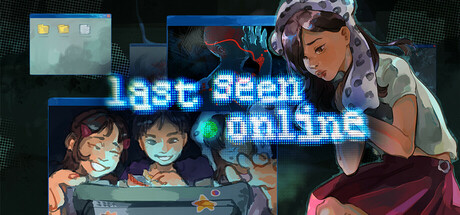
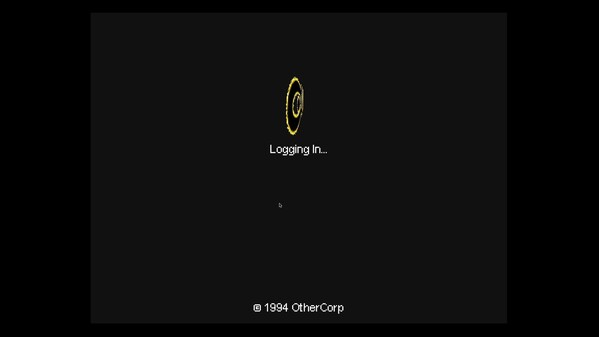
last seen online is a desktop replication game from Henry Quoc Tran in which you come into possession of a desktop PC from the early 2000’s that used to belong to a young teen. You load up old IM messages, receive new ones now that you’ve brought the former owner’s account back online, peruse music playlists, view photos, read a journal, and solve puzzles to get past passwords and other locked doors.
My first experience with the desktop replica genre was Cibele. In comparison, this game is less visual novel and more puzzle game, as accessing deeper and deeper into the hard drive requires finding the correct numbers, answers, clicks, and photos. It evolved to requiring writing notes to cross reference details and record what combinations to try. Some of the puzzles presented are real head scratchers but the game is so short it never becomes exorbitant.
The heart of the game is the fate of Liz, a young girl who performed a ritual to live within the MMO game she loved. While she succeeded she found that this was not a true escape. As the game’s population dwindled she found herself the lone remaining player. Trading feeling alone during life for being truly alone within a dead MMO. That is, until you happened to boot up her old PC.
last seen online makes its fiction feel real with its presentation and specific instances of text throughout. Reading some of her IM messages and especially the journal, it has that tricky substance of teen postingtm: part cringe, part oversharing, part despair. Most of it reads as real, convincingly presenting something that could be the same personal life adaptation that makes up Cibele’s narrative1. Teens were writing in journals, messaging in chat rooms, reblogging sad gifs on tumblr, and now talk to chatbots. All share the same base feeling of loneliness that seems endemic to adolescence. These pieces of data on a desktop are now all artifacts of a person that exist as a fragile testament to their existence. Though the presentation within the fiction is that Liz “disappeared” it is hard to read the ritual as anything other than an allegory for suicide.
Liz’s continued existence post-suicide does frustratingly stand as a parable of why you should not take your own life. What you think will be an escape will just be another type of hell. Taking your own life will cause unimaginable pain to those who cared for you, which is depicted by the continued messages from Liz’s best friend Emily and by Liz herself remembering Kevin whose locker was below her own. However condemning the individual who took their own life to a continued existence of pain and loneliness is unnecessarily cruel. It works in terms of being a scary concept to think of, but that already exists enough in Christian teachings of eternal damnation in hell. I grew up in an evangelical church, did a mission trip, lost my way, and am not quite sure what I would say my beliefs are anymore. I do believe that there is nothing beyond this current consciousness, however sad that may be. Liz’s eternal suffering within a digital hell is a mixture of sad, scary, and vile.
This pain, the kind that causes someone to take their own life, is familiar to me. There exists a depth of depression intense enough that it exists as a chronic pain inside, only ever numbed temporarily by distractions. For myself it was podcasts, masturbation, and occasionally alcohol that I would turn to. I could never fully escape the gravity of my depression. It was the kind of sadness that you cannot logic out of, be consoled, or medicated. I can only speak to my personal history, but I believe this is the kind of loneliness and depression experienced by Liz. They were led by an internet rumor to take their own life to erase the pain, and I can empathize with that decision. Her continued suffering is one of truly eternal loneliness on the digital plane, exacerbated by the goodbyes of her best friend who has finally made peace with Liz’s non-existence.
This pain now exists as a fear I have that it will be experienced by my daughter. I fear that they will be similarly unreachable within it. I pray to be a more loving parent than Liz’s mother is presented as, but I fear even that may not be sufficient given the accounts of parents whose accepting and communicative methods were not enough. Not that this is a unique fear, but it is something rarely brought up with such substance within the medium of videogames. Its presence as a thing you can make enemies do in Cyberpunk 2077 far outnumbers its presence in games such as Soma.