[h1][b] Reseña de Hidden Prototype Top-Down 3D[/b][/h1]
[h2]Resumen del Juego[/h2]
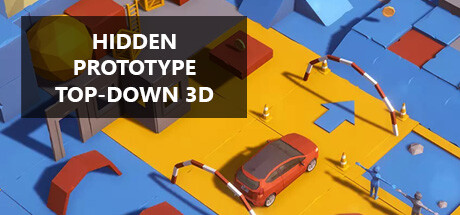
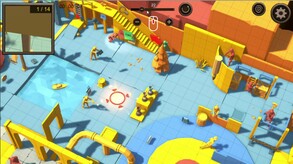
Hidden Prototype Top-Down 3D es ese “juego” que entra a la fiesta diciendo que hace de TODO: Acción, Aventura, Casual, Carreras, Rol, Simuladores, Deportes y Estrategia… y luego se queda parado en la esquina con un vaso de agua. La propuesta suena como licuado de géneros: vista top-down en 3D, con vibra de arcade, balacera, plataformas, lucha en 3D y hasta cosas tipo 4X/simulador de colonias/vida/agricultura (sí, también). En papel: ambicioso. En la práctica: prototipo escondido… y no tan escondido.
La primera impresión es la de un “cajón de sastre” experimental: un solo jugador, con 6 logros (lo suficiente para que Steam te suelte dopamina en microdosis) y una identidad que cambia cada dos pasos. Es indie en el sentido más puro: ideas por montones, pulido por momentos, y esa sensación de que el juego está probando si tú eres el beta tester que no pidió serlo.
Si buscas un híbrido raro para curiosear y reírte un poco (a veces con el juego, a veces del juego), aquí hay material. Si buscas una experiencia redonda en cualquiera de sus géneros… bueno, digamos que este “multi-herramienta” corta, pero no siempre donde tú querías.
[h2][b]Combos y Caos: Lo Bueno vs. Lo No Tan Bueno[/b][/h2]
Lo Bueno:
Mezcla descarada de géneros: arcade + acción + estrategia-ish en un solo paquete
Vista top-down 3D: clara para moverte, pelear y “probar cosas” sin mareos
6 logros: pocos, pero al menos hay objetivos definidos para picarte el orgullo
Ideal para sesiones casuales: entra, haces ruido, sales antes de que te pida compromiso
Lo No Tan Bueno:
Identidad difusa: cuando un juego promete ser carreras, rol, simulador, deportes y estrategia… normalmente no es ninguno “de verdad”
Comunidad fantasma: 0 jugadores actuales = sensación de estar jugando en un museo apagado
Recomendaciones totales: N/A, o sea, ni el algoritmo sabe a quién echártelo
Solo un jugador: si esperabas caos con amigos, aquí el único compañero es tu paciencia
[h2]Tabla de Evaluación[/h2]
[table]
[tr][th]Aspecto[/th][th]Puntuación (0-10)[/th][th]Comentario[/th][/tr]
[tr][td]Jugabilidad[/td][td]5[/td][td]Funciona como prototipo: entretenida a ratos, irregular en enfoque.[/td][/tr]
[tr][td]Dificultad / IA[/td][td]4[/td][td]Más “prueba de sistemas” que reto consistente.[/td][/tr]
[tr][td]Contenido[/td][td]4[/td][td]Mucho concepto, poca sustancia tangible por género.[/td][/tr]
[tr][td]Gráficos / Video[/td][td]5[/td][td]3D top-down cumplidor, sin presumir.[/td][/tr]
[tr][td]Historia[/td][td]3[/td][td]No se siente como prioridad; más sandbox de ideas.[/td][/tr]
[tr][td]Ambientación[/td][td]4[/td][td]Existe, pero no termina de amarrar una identidad.[/td][/tr]
[tr][td]Efectos (VFX)[/td][td]5[/td][td]Suficientes para la acción tipo arcade/balacera.[/td][/tr]
[tr][td]Música[/td][td]4[/td][td]Acompaña, pero no se queda contigo.[/td][/tr]
[tr][td]Voces[/td][td]2[/td][td]Prácticamente inexistentes o no relevantes.[/td][/tr]
[tr][td]Diversidad[/td][td]4[/td][td]Diverso en géneros, no necesariamente en profundidad.[/td][/tr]
[tr][td]Rendimiento[/td][td]6[/td][td]En general estable para lo que es: un experimento.[/td][/tr]
[tr][td]Rejugabilidad[/td][td]4[/td][td]Más curiosidad que ganas reales de volver muchas veces.[/td][/tr]
[tr][td][b]Total Puntuaciones (Mejorable)[/b][/td][td][b]4.2[/b][/td][td]Una idea con patas… pero todavía sin zapatos.[/td][/tr]
[/table]
[h2]Conclusión (Mejorable)[/h2]
Hidden Prototype Top-Down 3D es como ese amigo que dice “yo puedo con todo” y luego te pide que le expliques cómo se enciende la estufa. Tiene energía de laboratorio: pruebas de acción, pedacitos de aventura, momentos casuales, guiños a estrategia/simulación… y el resultado es una experiencia curiosa, pero claramente incompleta en enfoque.
Lo más controversial: el juego se vende como buffet de géneros, pero termina siendo una degustación. Y con 0 jugadores actuales, la vibra es de “tú y el prototipo contra el mundo”. Encima, con recomendaciones totales en N/A, no hay consenso comunitario: eres pionero… o el último en llegar al planeta.
¿Vale la pena? Depende de tu tolerancia al caos y tu amor por lo experimental. Si buscas algo pulido, mejor mira hacia otro lado. Si te gustan las rarezas y no te molesta sentir que el juego todavía está buscando qué quiere ser cuando sea grande, aquí hay algo que rascar.
[h3]Recomendación de Compra (Solo para curiosos pacientes)[/h3]
Puntuación Total: 4.2/10
Número de jugadores activos al momento de hacer esta review: 0
Descuento máximo registrado: -99%
Veredicto: [i]Mejorable: interesante como experimento, flojo como experiencia completa.[/i]
Si lo tuyo es explorar prototipos, coleccionar logros rápidos y reírte con (y de) decisiones de diseño “valientes”, adelante. Si esperas un juego sólido en acción, carreras, rol o estrategia, este es el equivalente a pedir un combo gigante y que te den papas… sin sal.