GUTTER: The Cursed is a bleak, abrasive, and strangely humorous indie role-playing game that throws players into a collapsing industrial hellscape and dares them to survive long enough to make sense of it. Developed and published by Asocial Guarantee, the game is unapologetically raw in both presentation and tone, leaning into discomfort, moral ambiguity, and systemic cruelty as defining features rather than flaws. It is a game that feels intentionally hostile, not just in its world design but in its narrative philosophy, constantly reminding players that safety, clarity, and justice are luxuries long abandoned in the city of Gutter.
The premise immediately establishes the game’s oppressive atmosphere. Upon arrival in the city, the protagonist is robbed, assaulted, and cursed with a terminal condition that functions as both a narrative hook and an existential timer. This curse is not merely a story device but a thematic anchor, framing every decision with urgency and dread. Gutter itself is a sprawling, decayed industrial labyrinth populated by desperate humans, predatory demons, and indifferent machines, all competing for survival and dominance. The city feels alive in its hostility, a place where exploitation is routine and morality is negotiable at best.
Gameplay unfolds from a top-down perspective, blending classic RPG exploration with choice-driven narrative design. Progression is deliberately nonlinear, allowing players to wander through districts, engage with factions, and pursue goals in an order shaped largely by circumstance rather than heroism. Combat exists, but it is rarely empowering; encounters often feel risky and scrappy, reinforcing the idea that violence is a last resort rather than a reliable solution. Resource scarcity, reputation, and alliances play a significant role, encouraging players to weigh long-term consequences against immediate survival.
One of the game’s most compelling aspects is its faction system. Various groups—ranging from criminal organizations to ideological collectives and non-human entities—vie for influence within Gutter. Aligning with one faction often means alienating another, and the game rarely signals which choice is “correct.” Instead, it presents competing perspectives and lets outcomes unfold organically. These relationships shape not only narrative outcomes but also access to areas, resources, and endings, making player choice feel genuinely consequential rather than cosmetic.
Narratively, GUTTER: The Cursed oscillates between grim fatalism and biting dark humor. The writing is deliberately abrasive, often mocking both the player and the systems they engage with. Conversations can shift from bleak introspection to absurdity in a single exchange, reinforcing the sense that the world has lost any stable emotional footing. This tonal volatility will not resonate with everyone, but it gives the game a distinct voice that separates it from more self-serious dystopian RPGs. The humor, when it lands, feels like a coping mechanism rather than relief, underscoring the desperation that permeates the setting.
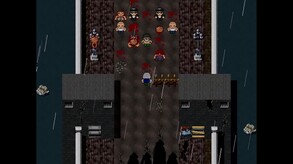
Visually, the game adopts a gritty pixel-art style that emphasizes atmosphere over polish. Environments are dense with industrial debris, flickering lights, and claustrophobic layouts that make navigation feel intentionally uncomfortable. Character sprites are expressive enough to convey personality, though animation is limited and often utilitarian. This roughness aligns with the game’s themes, though it also highlights its indie constraints. The sound design is sparse, relying on ambient noise and minimal music to reinforce isolation rather than spectacle.
Mechanically, the game can feel opaque and unforgiving. Systems are not always clearly explained, and trial-and-error is often required to understand how certain choices or mechanics function. Pacing can be uneven, with stretches of intense engagement followed by quieter periods of wandering or reading. These elements may frustrate players accustomed to streamlined RPG experiences, but they also contribute to the sense that Gutter is a place where clarity is scarce and mistakes are permanent.
Replayability is a notable strength for players willing to invest the time. Multiple endings, branching narrative paths, and faction outcomes encourage experimentation and repeat playthroughs. The existence of additional content tied to the same universe further expands the setting and reinforces the feeling that Gutter is a larger ecosystem rather than a single contained story. Each run can reveal new perspectives on familiar events, reframing previous decisions in unexpected ways.
Ultimately, GUTTER: The Cursed is not designed to be comfortable or broadly appealing. It is a deliberately abrasive indie RPG that values atmosphere, agency, and thematic coherence over accessibility or refinement. Its rough edges, tonal unpredictability, and mechanical opacity are inseparable from its identity. For players who appreciate choice-driven narratives, morally gray worlds, and games that challenge rather than reassure, it offers a distinctive and unsettling journey through a city that devours hope as readily as it consumes the unwary.
Rating: 7/10