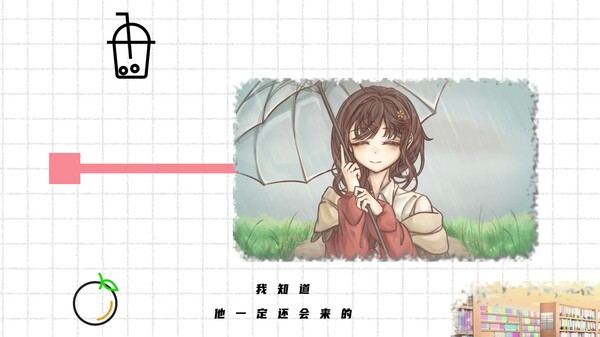
恋与未歇之雨 is a reflective and emotionally driven visual novel that blends romance, psychological mystery, and philosophical fantasy into a surprisingly thoughtful narrative experience. While the game initially appears to follow the structure of a gentle romantic drama centered around forgotten memories and reunited companions, it gradually evolves into something far more introspective and emotionally layered. The story explores themes involving perception, identity, emotional truth, and the fragile relationship between memory and reality, creating a dreamlike atmosphere that constantly balances tenderness with quiet uncertainty.
The narrative follows Yang, a protagonist struggling with fragmented memories and emotional confusion after awakening in a world that no longer feels entirely stable or familiar. Soon after, he reconnects with a girl named Xiaoyu, who claims to share a deep emotional history with him as both his childhood friend and romantic partner. Together they begin revisiting locations connected to their forgotten past in an attempt to uncover the truth behind Yang’s lost memories and the strange emotional inconsistencies surrounding their relationship. As the story unfolds, reality itself begins to feel increasingly unreliable, and the emotional bond between the two characters becomes intertwined with larger questions involving perception, belief, and subjective truth.
One of the game’s greatest strengths is its atmosphere. The entire experience carries a calm but emotionally uneasy tone that constantly makes the world feel fragile and unstable. The narrative unfolds almost like a dream where ordinary moments are quietly distorted by uncertainty and emotional tension. Conversations frequently feel layered with hidden meaning, while the gradual recovery of memories transforms seemingly peaceful interactions into emotionally loaded encounters filled with doubt and introspection. The game rarely relies on dramatic twists or shocking reveals. Instead, it builds emotional weight slowly through mood, symbolism, and character vulnerability.
The writing is mature and surprisingly philosophical for a smaller visual novel project. Rather than focusing entirely on romantic progression, the story spends significant time examining emotional dependency, memory, personal perception, and the way people construct their understanding of reality through belief and emotion. The central romance between Yang and Xiaoyu feels intimate and emotionally sincere because it develops gradually through quiet interactions and reflective dialogue rather than exaggerated melodrama. Their relationship constantly raises difficult emotional questions about whether feelings remain authentic when memories themselves may be unreliable or manipulated.
Character writing is one of the most compelling aspects of the experience. Yang is portrayed as emotionally uncertain and psychologically vulnerable, making his search for truth feel deeply personal rather than purely plot-driven. His inability to fully trust his own memories creates constant emotional instability throughout the story. Xiaoyu, meanwhile, emerges as a far more layered character than she initially appears. At times she feels warm, affectionate, and comforting, while in other moments she carries an emotional ambiguity that suggests hidden pain or unresolved motives beneath her gentle personality. This uncertainty keeps the relationship emotionally engaging throughout the narrative.
Visually, the game embraces a soft and nostalgic anime-inspired art direction that perfectly supports its emotional themes. Character portraits are expressive and carefully designed to emphasize emotional nuance during conversations and intimate scenes. Backgrounds often appear dreamlike or slightly detached from reality, reinforcing the story’s surreal atmosphere without relying on excessive fantasy spectacle. The color palette and lighting frequently create a calm but melancholic mood, making even ordinary environments feel emotionally significant. While the production values remain relatively modest compared to larger visual novels, the visual presentation succeeds because it consistently prioritizes emotional immersion and atmosphere.
The soundtrack further strengthens the emotional tone of the experience. Gentle piano melodies, ambient tracks, and melancholic compositions create a reflective atmosphere that quietly supports the narrative without overwhelming it. The music often emphasizes loneliness, nostalgia, and emotional uncertainty, allowing scenes to linger emotionally rather than rushing toward dramatic intensity. Silence is also used effectively, making quieter conversations feel more intimate and psychologically fragile. Combined with the dreamlike visuals, the soundtrack helps create a world that feels emotionally suspended somewhere between memory and imagination.
Gameplay follows the traditional structure of a visual novel, focusing mainly on dialogue, story progression, and occasional narrative choices that influence the direction of the story and its endings. Mechanically, the experience remains simple, but the branching paths provide enough variation to encourage replayability and deeper interpretation of the narrative themes. Different choices subtly alter emotional dynamics and reveal alternate perspectives regarding the relationship between Yang and Xiaoyu, making repeated playthroughs valuable for fully understanding the story’s emotional and philosophical layers.
One of the more interesting aspects of the game is how it handles its central philosophical premise. In this world, belief itself has the power to shape reality, meaning that memory, perception, and emotional conviction directly influence the environment around the characters. The game uses this concept not simply as abstract science fiction, but as a way of exploring emotional truth and psychological dependency. Questions regarding whether reality is defined by objective facts or personal emotional experience become central to both the romance and the mystery surrounding Yang’s fragmented memories.
The pacing is intentionally slow and introspective, which may not appeal to all players. Much of the game focuses on emotional dialogue, reflective moments, and subtle psychological development rather than fast-moving plot progression. Some philosophical discussions revisit similar ideas multiple times, occasionally slowing the narrative momentum. Players seeking highly interactive gameplay or constant dramatic twists may find the experience too subdued or passive.
However, this slower structure is also one of the reasons the emotional storytelling feels so effective. The game allows relationships and emotional uncertainty to develop naturally without rushing major revelations. Its smaller scale ultimately benefits the narrative because the story remains tightly focused on its emotional themes and central relationship rather than becoming overcrowded with unnecessary subplots.
For players who enjoy introspective visual novels, philosophical romance stories, and emotionally atmospheric narratives, 恋与未歇之雨 offers a surprisingly compelling experience. While its slow pacing and dialogue-heavy structure may not appeal to everyone, its emotional sincerity, dreamlike atmosphere, and psychologically layered storytelling help it stand out among smaller indie visual novels. It is a reflective and emotionally delicate journey about memory, perception, and the fragile truths people choose to hold onto when reality itself becomes uncertain.
Rating: 8/10