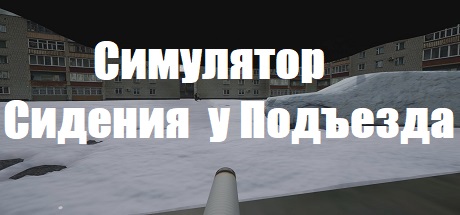
Симулятор Сидения у Подъезда is an intentionally absurd and culturally specific indie experience developed by GopStop Interactive and published by Kavkaz Sila Games that takes the idea of a “simulator” to its most literal and ironic extreme. Rather than simulating a profession, a complex system, or a heroic journey, the game focuses entirely on a single mundane activity: sitting outside an apartment building entrance. What initially sounds like a joke is, in practice, a self-aware, atmospheric, and oddly effective slice-of-life parody that turns idleness, routine, and street culture into the main attraction.
From the moment you load in, the game makes its intentions clear. You are placed in a bleak but familiar courtyard environment rendered from a first-person perspective, complete with worn benches, concrete walls, parked cars, snow or dirt underfoot, and the unmistakable aesthetic of a post-Soviet residential block. There is no tutorial in the traditional sense because there is very little to learn. You sit, you observe, you occasionally interact. This minimalism is not accidental; it is the core of the experience. The game is less concerned with giving you something to do and more interested in letting you exist in a specific space and mindset.
Interactivity is deliberately limited but thematically consistent. You can change how you sit, light a cigarette, shift your view, and shout various phrases using local slang, profanity, or casual banter. These actions do not advance a story or unlock new systems, but they contribute to the feeling of inhabiting a familiar social ritual. Non-player characters occasionally pass through the courtyard, reinforcing the sense that this is a shared public space rather than a stage built around the player. The lack of structured interaction mirrors the real-life experience the game is parodying, where the act of “doing nothing” is itself the activity.
The tone of the game walks a careful line between satire and affection. It leans heavily into stereotypes associated with street culture, clothing, language, and mannerisms, but it does so with an exaggerated, almost cartoonish self-awareness. For some players, this comes across as pure meme fuel—a digital joke meant to be laughed at, streamed, or shared in screenshots. For others, especially those familiar with the cultural context being depicted, there is an undercurrent of nostalgia and recognition that gives the game unexpected resonance. It captures a specific social atmosphere that is rarely represented in games, even if it does so through humor and exaggeration.
Visually, the game is simple but purposeful. The environment is not highly detailed, but it doesn’t need to be. Its roughness and sparseness contribute to the authenticity of the setting. Lighting, ambient sounds, and environmental stillness do much of the heavy lifting, creating a mood that feels static, cold, and quietly lived-in. The lack of dramatic music or scripted events reinforces the sense of waiting and passing time, which is central to the game’s identity.
There is no progression system, no objectives, and no end state. You are not rewarded for sitting longer, interacting more, or discovering hidden content. This design choice is crucial to understanding the game’s intent. By stripping away goals and feedback loops, Симулятор Сидения у Подъезда becomes a commentary on both everyday life and the simulator genre itself. It challenges the expectation that games must constantly reward engagement, instead presenting an experience where the value lies entirely in mood, humor, and cultural reference.
Community reception reflects this unusual design philosophy. Many players praise the game for committing fully to its joke and atmosphere, appreciating it as a parody, a cultural snapshot, or a digital performance piece rather than a traditional game. Others criticize it for having “nothing to do,” which is both a fair observation and an ironic confirmation that the game achieves exactly what it sets out to do. Its popularity within a niche audience suggests that there is room in the medium for experiences that exist purely as commentary or experiential humor.
In the end, Симулятор Сидения у Подъезда is not a game meant to be judged by conventional standards of gameplay depth or mechanical variety. It is an interactive joke, a cultural vignette, and a minimalist simulator rolled into one. Players looking for structure, challenge, or progression will likely bounce off it quickly. Those who appreciate satire, absurdist design, or culturally specific humor may find it strangely compelling. As an example of how indie developers can stretch the definition of what a game can be, it stands as a small but memorable experiment that turns doing nothing into the entire point.
Rating: 8/10