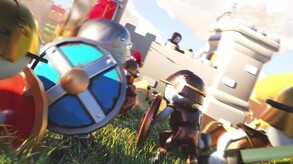
Feudal Friends, developed and published by Keep Games, is a cooperative strategy and tower defense hybrid that seeks to blend the tactical decision-making of resource management with the camaraderie and chaos of multiplayer teamwork. Set in a stylized medieval world, the game puts players in charge of building, defending, and expanding their own fortress while battling against opposing castles. The premise is simple yet appealing: work together with up to three other players to create a thriving base, equip your soldiers, and send them into battle to crush the enemy. It’s a concept that immediately suggests the potential for both strategic depth and lively cooperative play, with each player assigned specific responsibilities that, when executed well, can make for an engaging and hectic experience.
At its foundation, Feudal Friends is built around teamwork and role specialization. Players take on different duties such as managing production, forging weapons, crafting armor, or commanding troops on the battlefield. Each role contributes to the greater goal of fortifying the team’s defenses and launching successful offensives. This design fosters a sense of interdependence that can make coordination both rewarding and challenging. When everything clicks—when one player is efficiently managing resources while another upgrades troops and another handles combat—the game achieves an energetic rhythm that few co-op titles can replicate. The feeling of building a functioning medieval war machine with friends is genuinely satisfying. However, this reliance on coordination is also a double-edged sword. Feudal Friends is not designed to be played alone, and without reliable teammates, much of its intended fun falls apart. The lack of a meaningful single-player mode or well-developed AI substitutes means that those looking to play solo will quickly find the experience hollow.
The gameplay loop revolves around producing resources, forging equipment, upgrading defenses, and deploying units in real-time to push toward the enemy’s castle. Battles unfold in waves, with each team trying to outlast the other while maintaining production efficiency at home. It’s a clever mixture of tower defense and light RTS mechanics, but its execution isn’t always smooth. The controls can feel cumbersome, particularly during high-intensity moments when multiple actions are needed at once. Navigating menus and issuing commands can become frustrating, especially for players managing more complex roles like blacksmith or commander. The user interface, while functional, lacks the refinement needed for such a multitasking-heavy game. This can make even simple actions—like upgrading troops or switching tasks—feel unnecessarily clunky. These issues aren’t game-breaking, but they contribute to a general sense of roughness that diminishes what could have been a much smoother cooperative experience.
Visually, Feudal Friends adopts a colorful, cartoon-inspired aesthetic that fits its lighthearted medieval theme. The art direction emphasizes clarity over realism, allowing players to easily identify characters, structures, and resources in the heat of battle. The animations are simple but charming, and the overall presentation maintains a cohesive style that complements the game’s playful tone. However, the polish doesn’t extend evenly across all elements. Some of the environmental textures and UI components feel underdeveloped, and the sound design, while serviceable, lacks the dynamic impact that might have made battles more exciting. Despite these shortcomings, the visual identity works well enough to support the game’s core mechanics and multiplayer focus. It’s clear that the developers aimed for an accessible, casual feel rather than a gritty or realistic atmosphere, which fits the cooperative party-game vibe they were going for.
The experience of playing Feudal Friends depends heavily on the group dynamic. When played with friends who communicate effectively, the game can be entertaining and chaotic in the best possible way. It’s easy to get lost in the rhythm of managing tasks and watching your collective strategy unfold. But when communication breaks down or when players fail to fulfill their roles, the system starts to crumble quickly. Matches can feel unbalanced, and the pressure to micromanage can lead to frustration. This is compounded by pacing issues; early stages of matches often move slowly, while later phases can become overwhelming as the screen fills with action and overlapping responsibilities. The progression curve is uneven, creating stretches of downtime followed by frantic bursts of activity that don’t always feel cohesive. Still, the underlying design remains sound—it’s simply limited by execution and the necessity of having the right team dynamic to make it work.
Performance-wise, Feudal Friends runs adequately on most systems, though it is not free from technical quirks. Players have reported occasional lag, minor glitches, and interface bugs that can disrupt the flow of gameplay. These problems don’t ruin the experience, but they add to the impression of a project that could benefit from additional polish and optimization. More problematic is the lack of a strong matchmaking system. Since the game’s strength lies in cooperative play, finding other players to team up with should be effortless, yet the community is relatively small, and connection issues are not uncommon. Without a consistent player base or AI companions, the game risks losing potential new players who can’t access the cooperative experience it was designed around. This reliance on external coordination and server stability highlights how fragile the core experience can be when those elements aren’t in sync.
Feudal Friends ultimately feels like a game filled with good ideas that haven’t been fully realized. Its concept—a cooperative medieval tower defense where each player manages a distinct role—is genuinely interesting, and in moments where it works, it captures the joy of teamwork beautifully. But the lack of single-player depth, inconsistent controls, technical hiccups, and limited community support all hold it back from reaching its potential. It’s an indie title that clearly carries the enthusiasm of its creators but not quite the refinement or scale needed to sustain its vision long-term. For players with a group of friends who enjoy cooperative challenges and don’t mind a few rough edges, it can provide several hours of fun and creative chaos. For those seeking a polished or solo-friendly experience, however, it may feel incomplete. Feudal Friends stands as an example of a promising idea that shines brightest in company but struggles to stand on its own.
Rating: 6/10