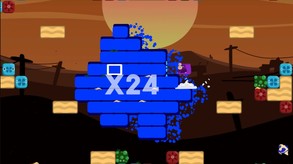
Fat Mask, developed and published by Paper Cult, is a compact yet surprisingly intense arcade-style game that blends competitive puzzle mechanics with fast-paced platforming and brawler-like disruption. At first glance, it presents itself as a quirky indie curiosity, but beneath its simple visuals lies a tightly focused design built around speed, spatial awareness, and constant player interaction. It is a game that thrives on pressure and proximity, favoring chaotic moments and split-second decisions over long-term planning or progression systems.
The central mechanic of Fat Mask revolves around collecting and assembling blocks into large combo structures while navigating small, enclosed arenas. Players must grab blocks, stack them carefully, and protect their growing combos long enough to score. This puzzle-like objective is immediately complicated by the presence of other players, who are actively encouraged to interfere, steal blocks, and dismantle your progress. Unlike traditional puzzle games where failure is internal and self-inflicted, Fat Mask externalizes that tension, turning every opponent into a moving hazard that can undo seconds of careful setup in an instant.
Movement and controls are deliberately straightforward, focusing on jumping, grabbing, and quick positioning. This simplicity keeps the game accessible while allowing depth to emerge naturally through competitive play. Mastery comes not from memorizing complex inputs, but from learning how to read opponents, control space, and decide when to commit to building a combo or abandon it to disrupt someone else’s. The arenas are small enough that no action goes unnoticed, and the constant proximity ensures that every decision carries immediate consequences.
The pacing is relentless. Matches are short, energetic, and rarely allow players to settle into a comfortable rhythm. Even brief lapses in attention can result in stolen combos or sudden reversals of fortune. This creates a strong sense of momentum that keeps sessions engaging, particularly in multiplayer, where the flow of a match can shift dramatically in seconds. The balance between offensive play—building and securing combos—and defensive or disruptive tactics adds an unexpected layer of strategy to what initially appears to be a simple arcade experience.
Local multiplayer is clearly the heart of Fat Mask. Designed for up to four players on a single screen, it captures the spirit of classic couch party games where competition is as much social as it is mechanical. Matches often devolve into playful chaos, with players targeting whoever is currently winning or forming temporary alliances that dissolve just as quickly. The game excels in these moments, creating bursts of laughter, frustration, and rivalry that feel organic rather than scripted. It is the kind of game that benefits enormously from shared physical space and direct social interaction.
For solo players, Fat Mask offers a more focused, skill-driven experience through its score-based modes and leaderboards. Without other players interfering, the game becomes a test of efficiency, precision, and optimization. Solo play highlights the underlying puzzle design, challenging players to build and maintain combos under increasing pressure. While it lacks the unpredictable energy of multiplayer, it provides a satisfying way to engage with the mechanics on a more personal level and offers a reason to keep improving performance over time.
Visually, the game is minimalistic but expressive. Characters and environments are simple, readable, and intentionally uncluttered, ensuring that gameplay clarity is never compromised. The art style supports the arcade sensibility, keeping the focus on motion and interaction rather than decorative detail. Sound design and music reinforce the game’s energetic tone, with effects that provide clear feedback and audio cues that heighten the sense of urgency. Humorous touches sprinkled throughout—such as deliberately silly animations or actions—underscore the game’s refusal to take itself too seriously.
In terms of longevity, Fat Mask is not designed to be a long-form experience. There are no progression trees, unlock-heavy systems, or narrative arcs to chase. Instead, its replay value is rooted in competition, mastery, and social play. This makes it highly effective in short bursts or party settings, but potentially less compelling for players seeking extended solo engagement or structured advancement.
Overall, Fat Mask is a tightly designed arcade party game that succeeds by fully committing to its core idea. It blends puzzle mechanics and platforming into a fast, competitive format that rewards aggression, awareness, and adaptability. While its scope is small and its appeal niche, it delivers a focused, high-energy experience that shines brightest in multiplayer settings. For players who enjoy couch competition, chaotic interactions, and games where victory can be stolen in a heartbeat, Fat Mask offers a sharp, memorable slice of indie arcade design.
Rating: 6/10