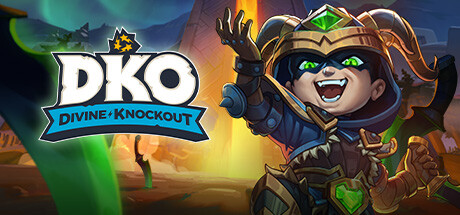
KO the gods in the world’s only 3rd-person platform fighter! Become a small-but-mighty god of myth, brawl in all three dimensions, and knock your friends off the map to reign supreme.
Modeled estimate, not a reported figure. How we estimate →
Media

About
Services for this title will be shutting down on February 17, 2025.
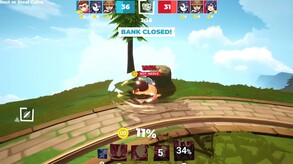
Damage enemies to make them vulnerable, then knock them out of the arena with a mighty blow! Enjoy combat inspired by 2D platform fighters, but brought into a unique third-person perspective.
Each arena features a new mechanic that players must master to win. Some crumble over time, while others feature deadly traps.
Hurl boulders as Hercules, swing Excalibur as King Arthur, or wield Mjolnir as Thor. Unleash each god’s devastating abilities at the push of a button.
In DKO’s core 3v3 mode, each round is a new adventure – and a new mode like Knockout or King of the Hill. Or play intense 2v2 and 1v1 duels, focused entirely on combat.
With full cross-play and cross-progression, you can play anyone, anywhere.
Customize each god to play exactly how you want, and to show your unique style.
New gods, maps, cosmetics, and modes are released regularly.
Genres
Stats
Languages: English*, French, German, Japanese, Spanish - Latin America, Simplified Chinese, Portuguese - Brazil*languages with full audio support
Engagement
Reviews
Themes across 40 recent reviews and how positive each mention is. A keyword signal, not full sentiment analysis.
Reviews
this game was peakkkk
I Love this game i hope the servers go on again someday.. its by far the best game ive everplayed and i had so much fun everytime.. pls bring it back
浪费时间,要打发时间的话可以
Related
Related
Trends
Modeled estimate over time.
Hours played at review time, across 40 reviews with recorded playtime.
positive critical· bar length = how often the theme comes up
If they actually supported it, this could of been super fun! Its a shame that I spent actual money to enjoy this game for like 2 months lol
Muito bom para jogar com amigos
Divine Knockout, or DKO, is an ambitious multiplayer brawler that attempts to combine the accessibility of platform fighters with the spectacle of mythological combat. Developed by Red Beard Games and published by Hi-Rez Studios, the game takes familiar gods from various mythologies and throws them into fast-paced arena battles built around knockback mechanics, special abilities, and team coordination. Rather than following the traditional side-scrolling format used by most platform fighters, DKO adopts a fully 3D third-person perspective, giving the gameplay a unique identity that separates it from many competitors in the genre. While the game struggled to maintain a large player base over time, the foundation itself remains surprisingly enjoyable and full of creative ideas. The gameplay focuses on launching opponents out of arenas rather than simply draining health bars. Players build damage percentages through attacks and abilities until enemies become vulnerable enough to be knocked off the map. This structure immediately creates intense and chaotic matches where positioning becomes just as important as offensive skill. The third-person camera changes the pace significantly compared to traditional platform fighters because movement feels more dynamic and less predictable. Dodging attacks, recovering from knockback, and maneuvering around arena hazards all become more immersive when viewed from behind the character rather than from a flat side perspective. One of the game’s strongest features is its use of mythological characters. DKO draws inspiration from the SMITE universe, bringing together gods and legendary figures from multiple cultures including Greek, Norse, Egyptian, Japanese, and more. Characters such as Thor, Hercules, Athena, Susano, and Amaterasu all possess unique movesets that reflect their mythological backgrounds. Each god feels mechanically distinct, encouraging players to experiment with different fighting styles. Some characters excel at aggressive close-range pressure, while others focus on mobility, ranged attacks, or crowd control. This variety helps the roster remain entertaining even though the overall number of playable characters is smaller than many major fighting games. Combat feels accessible without becoming completely shallow. Basic attacks and abilities are simple enough for casual players to understand quickly, allowing newcomers to jump into matches without feeling overwhelmed. However, the game still rewards timing, positioning, and mechanical skill. Advanced players can chain together combos, predict enemy movement, and use abilities strategically to control space or set up knockouts. Team coordination becomes especially important in objective-based modes where communication and ability synergy can completely shift the outcome of a match. The game modes provide a decent amount of variety. Standard elimination battles work well for players who enjoy straightforward competitive action, while objective-focused modes encourage more strategic thinking and teamwork. The smaller arena sizes help maintain fast pacing, ensuring that matches rarely slow down for long periods. Team fights often become chaotic spectacles filled with explosions, knockback effects, and overlapping abilities, creating moments that feel exciting even when the gameplay becomes somewhat messy. Visually, DKO adopts a bright and colorful art style that fits its arcade-inspired design philosophy. Character animations are fluid and expressive, and the exaggerated effects make abilities feel impactful during combat. Arenas are inspired by mythological settings and generally contain enough visual variety to remain interesting over repeated matches. The art direction prioritizes readability and personality over realism, which works well for the game’s energetic tone. Even when multiple players are fighting simultaneously, the visual presentation usually remains clear enough to follow the action. Sound design also plays a major role in making combat feel satisfying. Attacks carry strong audio feedback, abilities sound appropriately powerful, and the soundtrack maintains a high-energy atmosphere during matches. Voice lines help reinforce the personalities of the gods, adding extra charm to the roster. The presentation overall feels polished, reflecting Hi-Rez Studios’ experience with multiplayer-focused games and live-service design. Despite its strengths, Divine Knockout struggled with long-term content support and player retention. One of the biggest issues was repetition. Although the combat system itself was fun, the amount of available content felt somewhat limited after extended play sessions. The map pool was relatively small, and progression systems lacked enough meaningful rewards to keep some players engaged for the long term. Without a steady stream of major updates or new content, matchmaking eventually became inconsistent as the player population declined. Balance issues also created frustration at times. Certain characters occasionally dominated the competitive environment due to overpowered abilities or particularly effective combinations, leading to repetitive matches where the same gods appeared constantly. While balance patches improved some problems, the game never fully escaped complaints about character balance and matchmaking fairness. The third-person perspective, while creative, introduced occasional camera problems during crowded fights. Matches involving multiple players near arena edges could become visually confusing, especially when knockback effects and abilities filled the screen simultaneously. Players familiar with traditional platform fighters may also need time to adjust to the different spatial awareness required by DKO’s camera system. Even with these flaws, Divine Knockout deserves credit for trying something genuinely different within the multiplayer fighting genre. Instead of simply imitating existing platform fighters, it experimented with perspective, movement, and arena design in ways that helped it establish its own personality. The result is a game that feels approachable, energetic, and highly entertaining when played casually with friends or coordinated teammates. What ultimately makes DKO memorable is its combination of mythology and arcade chaos. Watching legendary gods clash across floating arenas while launching each other into the sky creates a spectacle that rarely stops being entertaining. The game succeeds at delivering quick bursts of multiplayer fun while remaining accessible enough for players who may not normally enjoy competitive fighting games. Divine Knockout may not have reached the long-term success originally expected from it, but the core gameplay still offers a creative and enjoyable arena fighting experience packed with personality and fast-paced action. Beneath its missed potential lies a genuinely fun multiplayer brawler that experimented with the genre in ways few other games have attempted. Rating: 8/10
muito top
para mi tenia muchisimo potencial , no he encontrado un juego que sea igual o mas o menos similar a este en todos los aspectos , me encantaba jugarlo , quiza lo unico malo eran los servidores , pero por lo demas me encantaba , una lastima que no lo hayan continuado
Fun to play, cool art style. RIP
good
Momentum
Pace estimated from the game's recent review growth (our daily snapshots) at its own sales-per-review ratio — a momentum signal, not booked sales.
Audience
Estimated from the language of this game's reviews — a proxy for where players are, not official Steam demographics.
Related
| Omega Strikers | $0 | 23.6K | 84% | Free |
| SMASH LEGENDS | $0 | 10K | 69% | Free |
| Fantasy Strike | $0 | 2.1K | 61% | Free |
| Plants vs. Zombies™ Garden Warfare 2: Deluxe Edition | $29.4M | 49.4K | 90% | $29.99 |
| SMITE® | $0 | 119.9K | 79% | Free |
| Predecessor | $0 | 8.6K | 77% | Free |