Co-Ape : Rise Of The Monke developed and published by DepthinVision is an unusual cooperative platformer that revolves around a simple yet surprisingly demanding idea: two minds controlling a single character while attempting to climb a towering vertical obstacle course. At first glance the concept appears lighthearted and humorous, but the gameplay quickly reveals itself to be a test of precision, coordination, and communication. The game blends physics-based climbing mechanics with cooperative problem-solving, creating an experience where success depends as much on teamwork as it does on individual skill.
The premise places players in control of a small monkey whose journey centers on ascending a tall structure filled with platforms, narrow ledges, and precarious obstacles. Rather than giving each player a separate character, the game divides the control of the monkey between two players, symbolizing two halves of the same mind working together. Each participant influences different aspects of movement, which means that neither player can succeed alone. Even the simplest movement requires synchronized inputs, turning basic actions such as jumping or balancing into cooperative challenges.
Gameplay is centered entirely on vertical progression. The goal is to climb higher and higher through a sequence of increasingly difficult sections filled with gaps, unstable platforms, and awkward angles. Unlike traditional platformers that offer large environments to explore, this game focuses on a single towering climb where every section must be carefully navigated. A single mistake can send the monkey tumbling down to earlier sections of the structure, forcing players to repeat portions of the climb and try again. This constant risk of losing progress adds tension to every movement and encourages players to approach each jump with caution.
The physics-based movement system is a defining feature of the experience. Instead of relying on perfectly predictable platforming controls, the character responds to momentum and balance in ways that require careful adjustments. Players must consider not only when to jump but also how their movements affect the character’s trajectory and stability. When two players are involved, the difficulty increases significantly because both participants must coordinate their actions with precise timing. The resulting gameplay often leads to moments of chaotic humor when a mistimed input causes an unexpected fall.
One of the game’s strongest design choices is how it transforms cooperation into the central mechanic rather than a secondary feature. In many multiplayer games, players can operate independently while sharing the same environment. In this case, however, both players are directly responsible for the same character’s movement. This creates a strong sense of shared responsibility, as every mistake or success belongs to both participants. The experience becomes as much about communication as it is about platforming skill.
The game supports both single-player and cooperative play, giving players different ways to approach the challenge. In single-player mode, one player must control both halves of the character’s movement simultaneously. This mode becomes a demanding test of dexterity, requiring the player to coordinate multiple control inputs at once. Cooperative mode, on the other hand, emphasizes teamwork and communication, often leading to amusing interactions between players as they attempt to coordinate their actions.
Difficulty settings add another layer of flexibility to the experience. The standard mode includes checkpoints and removes strict time limits, allowing players to focus on learning the climbing mechanics without excessive punishment for mistakes. A more demanding hardcore mode removes checkpoints and introduces a timer, turning the climb into a high-stakes endurance challenge. In this mode, every fall becomes a significant setback, and players must balance careful movement with efficient progress if they hope to reach the top.
Leaderboards encourage players to compete for faster climbing times and more efficient runs. Once players become comfortable with the mechanics, they may attempt to refine their strategies and optimize their movements to achieve better results. This competitive aspect adds replay value, particularly for players who enjoy mastering difficult mechanics and improving their performance through repeated attempts.
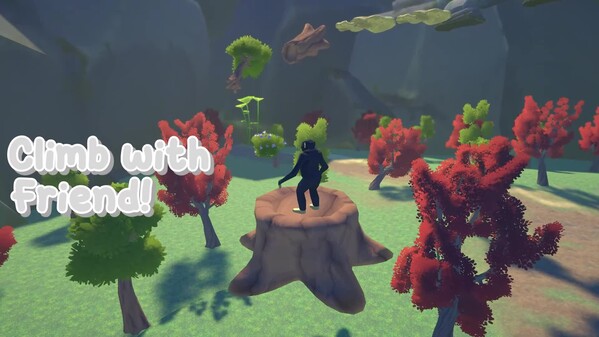
Visually, the game adopts a colorful and stylized 3D aesthetic that emphasizes clarity over realism. Platforms, obstacles, and climbable surfaces are designed with bright colors and clear shapes so that players can easily identify where they need to move next. The environments themselves are relatively simple, but this simplicity helps maintain focus on the core platforming mechanics rather than visual distractions.
The audio design reinforces the playful tone of the game. Background music provides a lighthearted atmosphere that contrasts with the tension of the climbing challenges. Sound effects for jumps, landings, and falls provide clear feedback that helps players understand the consequences of their actions. While the soundtrack is not particularly elaborate, it complements the game’s quirky personality and cooperative gameplay.
Despite its creative concept, the game does have certain limitations. Because the main objective revolves entirely around climbing a single structure, the gameplay can begin to feel repetitive during longer sessions. The environments do not vary significantly, and the obstacles primarily challenge players through mechanical difficulty rather than introducing entirely new gameplay ideas.
Another potential drawback lies in the demanding control system. The shared-control mechanic is intentionally challenging, but it may frustrate players who prefer traditional platforming controls. Frequent falls and repeated attempts are an expected part of the experience, which may discourage players who are less patient with trial-and-error gameplay.
Even so, the game succeeds in delivering a memorable cooperative challenge. Its unusual control scheme creates moments of genuine teamwork and laughter as players struggle to synchronize their movements. When a difficult section is finally completed through careful coordination, the sense of accomplishment feels especially rewarding.
Ultimately, Co-Ape : Rise Of The Monke stands out as an experimental indie platformer that explores the idea of shared control in a creative way. By turning cooperation into the core mechanic rather than a supporting feature, the game offers a distinctive climbing challenge that feels different from most traditional platformers. While its limited scope and repetitive structure may prevent it from appealing to everyone, it provides a unique and entertaining experience for players willing to embrace its unconventional design.
Rating: 7/10