A roguelike game of musou battle.
Modeled estimate, not a reported figure. How we estimate →
Media

About

Introduction to gameplay:
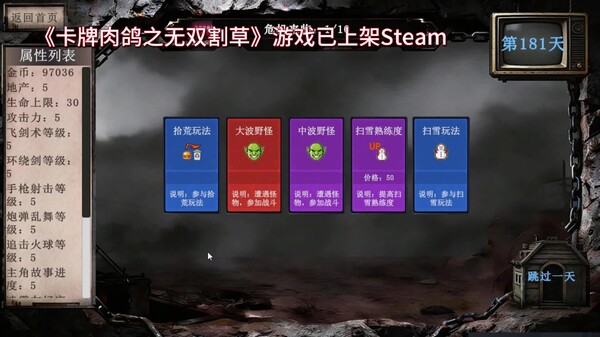
Players take on the role of survivors in a post-apocalyptic world, aiming to achieve a longer survival duration; daily actions are drawn from event cards;
Event cards possess a random nature, while combat skills exhibit a roguelike trait; only combat events can be chosen when the crisis cycle is reached.
Game functional features:
In battle, there is a large number of monsters to kill and skills to unleash, featuring an unparalleled combat mode; the types of combat skills are abundant and diverse in form;
Utilize AI to generate artistic resources; employ collision boxes and rigid bodies to handle combat effects; and utilize coroutines to handle a multitude of skill flight effects.
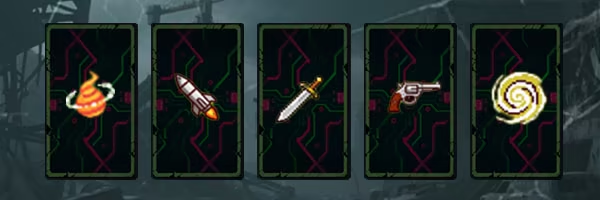
Introduction to combat skills:
Flying Sword Technique allows you to launch flying swords at enemies, with the number of swords launched increasing as your level increases;
Surrounding sword, the sword qi surrounding the protagonist. The higher the level, the more swords surround the protagonist;
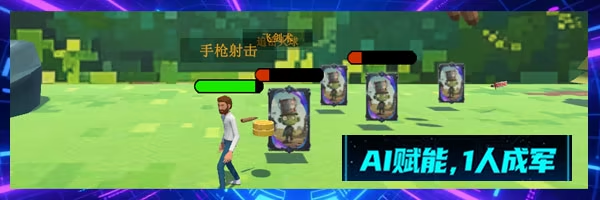
Pistol shooting, using a pistol to shoot continuously, the higher the level, the more bullets fired in a burst;
Cannonballs dance chaotically, summoning a volley of cannonballs. The higher the level, the greater the number of cannonballs summoned;
Pursue the fireball, and it will automatically pursue the enemy. The higher the level, the greater the damage value;
Other skills, skipped.
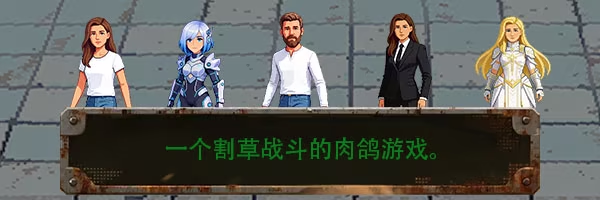
Introduction to Plot Characters:
Harrison, the protagonist played by the player, is a suave middle-aged man who was an ordinary office white-collar before he traveled through time. He has a calm and pragmatic personality;
Vera, the administrative backbone of the shelter, is capable and reliable in handling affairs, proficient in management and resource allocation, and maintains the daily order of the shelter amidst chaos;
Frost, the guardian of the Ice Blade, is a battle-hardened and agile female protagonist with a cold and commanding demeanor. Her appearance is cold and sharp, but deep down, she harbors unknown pasts and warmth;
Stella, the glorious martyr, a radiant lady with a warm demeanor who brings hope; her origins are mysterious, possibly stemming from other forces;
Other characters, skipped.
Author's Message:
This game is the result of 21 days and nights of collaborative work between an unemployed programmer and generative AI. We hope you enjoy it.
Stats
All-time low is the lowest price we've recorded for this game since we started tracking it.
Languages: Simplified Chinese
Reviews
Card Roguelike of Musou Farming is an unconventional indie title created by solo developer CHEN JIE that attempts to merge several very different gameplay styles into a single experimental experience. At first glance the title itself hints at the unusual blend of mechanics players can expect: roguelike progression, card-based decision systems, survival elements, and musou-inspired combat all coexist within a single gameplay loop. The game takes place in a bleak world where survival is uncertain and every day brings a new set of unpredictable circumstances. Rather than relying on a fixed storyline or structured campaign, the game leans heavily on procedural events and randomness, creating an experience where each playthrough unfolds differently depending on the cards drawn and the choices the player makes. The core of the game revolves around a card-driven event system that determines the player’s daily activities and progression. At the beginning of each cycle, the player is presented with a selection of cards representing different events, actions, or opportunities. These cards might involve interacting with characters, exploring areas, initiating combat, or engaging in smaller activities that can reward the player with resources, currency, or upgrades. Because these options are randomized, the player must carefully decide how to spend limited resources and time each day. Some cards require certain conditions or costs before they can be activated, while others provide immediate benefits but may also carry risks. This mechanic introduces a layer of strategy where survival depends not only on combat ability but also on resource management and decision-making. The roguelike structure reinforces the unpredictability of the experience. Each run through the game generates a different sequence of events, forcing players to adapt to changing circumstances rather than relying on a single optimal strategy. Some playthroughs might focus heavily on gathering resources or interacting with characters, while others may quickly escalate into repeated battles. The randomness encourages experimentation and replayability, as players gradually learn how to evaluate card choices and build more efficient survival strategies. Over time, players become familiar with the various card events and how they can influence a run, turning the early chaos into a more calculated form of planning. Combat sequences introduce the “musou” aspect of the game’s design. When battle events occur, the gameplay shifts from the slower pace of card management to real-time action where the player faces waves of enemies. These encounters emphasize spectacle and power, allowing the player to unleash a range of abilities that can wipe out large numbers of foes simultaneously. Skills such as launching flying swords, summoning orbiting blades, or firing rapid streams of projectiles create a sense of overwhelming force reminiscent of traditional musou titles. Rather than focusing on intricate tactical combat, the system encourages players to embrace large-scale destruction and crowd-clearing attacks as enemies swarm the battlefield. As players progress through runs, they gain access to additional skills and upgrades that enhance their combat capabilities. Abilities can be improved or modified, allowing them to deal greater damage, cover larger areas, or trigger additional effects. This progression adds a sense of momentum to each run, as the player gradually transforms from a vulnerable survivor into a powerful fighter capable of handling increasingly dangerous encounters. The growing arsenal of abilities also provides a satisfying sense of escalation, particularly during intense battles where multiple effects and attacks are active simultaneously. Outside of combat, the game’s event cards introduce small narrative fragments and gameplay diversions that help add variety to the overall loop. Some cards involve brief story interactions or choices that hint at the world’s background, while others lead to mini-games or activities that break up the pace of survival management. These moments may not form a fully developed narrative, but they help give the world a sense of texture and unpredictability. The mixture of different event types ensures that each day in the game can feel distinct, even if the underlying mechanics remain simple. Visually, the game reflects its indie origins and limited production scale. The graphics are functional rather than elaborate, prioritizing clarity during combat and event interactions. Effects during battles can become surprisingly flashy despite the overall minimalistic presentation, especially when multiple skills are active at once. The technical implementation relies on relatively simple systems such as physics collisions and scripted behaviors to handle combat interactions and projectile effects. While the visuals may lack the polish of larger titles, they effectively support the gameplay’s emphasis on chaotic action and procedural events. One of the game’s most interesting qualities is its willingness to experiment with genre combinations that rarely appear together. Roguelike card systems are typically associated with strategy or deck-building games, while musou combat focuses on large-scale action and power fantasies. By attempting to combine these ideas, the game creates a gameplay loop that alternates between thoughtful planning and explosive action. Players spend time weighing decisions during the card phases before being thrown into intense battles where quick reactions and powerful abilities take center stage. However, the experimental nature of the design also brings certain limitations. The heavy reliance on randomness can occasionally produce runs that feel uneven, particularly when the available cards do not align with the player’s current resources or needs. Combat encounters, while initially exciting, may eventually feel repetitive because they emphasize overwhelming attacks rather than varied enemy behaviors or tactical depth. Additionally, the world-building remains fairly minimal, leaving the player with only fragments of story rather than a fully developed narrative framework. Despite these shortcomings, Card Roguelike of Musou Farming stands out as a curious and inventive indie project that embraces experimentation. Its hybrid mechanics create a gameplay rhythm that shifts between planning, survival management, and fast-paced combat, offering a distinctive experience that does not easily fit into a single genre category. For players who enjoy unconventional indie titles and are interested in seeing how different gameplay systems can be fused together, the game provides a fascinating example of creative design, even if it occasionally feels rough around the edges. Overall, the game feels less like a polished mainstream release and more like a creative sandbox where ideas are tested and combined in unexpected ways. While it may not appeal to players seeking a deeply refined or narrative-driven experience, it offers an intriguing blend of roguelike mechanics, card-based decision making, and chaotic musou combat. Those willing to embrace its experimental nature may find it to be an engaging and unpredictable adventure that highlights the imaginative possibilities of small-scale indie development. Rating: 6/10
Related
Related
Trends
Concurrent players on Steam, sampled daily since tracking started.
Momentum
Pace estimated from the game's recent review growth (our daily snapshots) at its own sales-per-review ratio — a momentum signal, not booked sales.
Related
| Glasses and Girls | $315.6 | 51 | 82% | $0.99 |
| Bongo Quest | $322 | 52 | 46% | $0.99 |
| Dances and Girls | $322 | 52 | 83% | $0.99 |
| Anime Sunset Ride | $334.4 | 54 | 67% | $0.49 |
| Cosmic Journey PC Live Wallpaper | $336.3 | 52 | 71% | $0.99 |
| Forest and Girls | $340.5 | 55 | 82% | $0.99 |