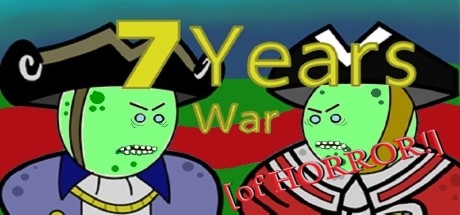
7 Year's war was one of the most uplifting and ethereal experiences in gaming that I have ever indulged in. From the stellar gameplay to the pinpoint historical accuracy, everything about this video-game is a plus from me. I particularly enjoyed the gripping story, and the extended lore of this scenario, so much so that I have decided to research and further inform myself over this topic. Here are some particularly noteworthy discoveries that I have found among my adventure of knowledge:
The Seven Years' War was a global conflict lasting from 1756 to 1763 that involved most of the European Great Powers, and was fought primarily in Europe, the Americas, and Asia-Pacific. Related conflicts include the French and Indian War, the Carnatic Wars and the Anglo-Spanish War (1762–1763). The opposing alliances were led by Great Britain and France respectively, both seeking to establish global pre-eminence at the expense of the other.[9] Along with Spain, France fought Britain both in Europe and overseas with land-based armies and naval forces, while Britain's ally Prussia sought territorial expansion in Europe and consolidation of its power. Long-standing colonial rivalries pitting Britain against France and Spain in North America and the West Indies were fought on a grand scale with consequential results. Prussia sought greater influence in the German states, while Austria wanted to regain Silesia, captured by Prussia in the previous war, and to contain Prussian influence.
In a realignment of traditional alliances, known as the Diplomatic Revolution of 1756, Prussia became part of a coalition led by Britain, which also included long-time Prussian competitor Hanover, at the time in personal union with Britain. At the same time, Austria ended centuries of conflict between the Bourbon and Habsburg families by allying with France, along with Saxony, Sweden and Russia. Spain aligned formally with France in 1762. Spain unsuccessfully attempted to invade Britain's ally Portugal, attacking with their forces facing British troops in Iberia. Smaller German states either joined the Seven Years' War or supplied mercenaries to the parties involved in the conflict.
Anglo-French conflict over their colonies in North America had begun in 1754 in what became known in the United States as the French and Indian War (1754–63), which became a theatre of the Seven Years' War when war was officially declared 2 years later, and it effectively ended France's presence as a land power on that continent. It was "the most important event to occur in eighteenth-century North America"[10] prior to the American Revolution. Spain entered the war in 1761, joining France in the Third Family Compact between the two Bourbon monarchies. The alliance with France was a disaster for Spain, with the loss to Britain of two major ports, Havana in the West Indies and Manila in the Philippines, returned in the 1763 Treaty of Paris between France, Spain and Great Britain. In Europe, the large-scale conflict that drew in most of the European powers was centred on the desire of Austria (long the political centre of the Holy Roman Empire of the German nation) to recover Silesia from Prussia. The Treaty of Hubertusburg ended the war between Saxony, Austria and Prussia, in 1763. Britain began its rise as the world's predominant colonial and naval power. France's supremacy in Europe was halted until after the French Revolution and the emergence of Napoleon Bonaparte. Prussia confirmed its status as a great power, challenging Austria for dominance within the German states, thus altering the European balance of power.
What came to be known as the Seven Years' War (1754/1756–1763) began as a conflict between Great Britain and France in 1754, when the British sought to expand into territory claimed by the French in North America. The war came to be known as the French and Indian War, with both the British and the French and their respective Native American allies fighting for control of territory. Hostilities were heightened when a joint British and native Mingo force (led by a 22-year-old Lieutenant Colonel George Washington and Chief Tanacharison) ambushed a small French force at the Battle of Jumonville Glen on 28 May 1754. The conflict exploded across the colonial boundaries and extended to Britain's seizure of hundreds of French merchant ships at sea.
Prussia, a rising power, struggled with Austria for dominance within and outside the Holy Roman Empire in central Europe. In 1756, the four greatest powers "switched partners" so that Great Britain and Prussia were allied against France and Austria. Realizing that war was imminent, Prussia pre-emptively struck Saxony and quickly overran it. The result caused uproar across Europe. Because of Austria's alliance with France to recapture Silesia, which had been lost in the War of the Austrian Succession, Prussia formed an alliance with Britain. Reluctantly, by following the Imperial diet of the Holy Roman Empire, which declared war on Prussia on 17 January 1757, most of the states of the empire joined Austria's cause. The Anglo-Prussian alliance was joined by a few smaller German states within the empire (most notably the Electorate of Hanover but also Brunswick and Hesse-Kassel). Sweden, seeking to regain Pomerania (most of which had been lost to Prussia in previous wars) joined the coalition, seeing its chance when all the major continental powers of Europe opposed Prussia. Spain, bound by the Pacte de Famille, intervened on behalf of France and together they launched an unsuccessful invasion of Portugal in 1762. The Russian Empire was originally aligned with Austria, fearing Prussia's ambition on the Polish–Lithuanian Commonwealth, but switched sides upon the succession of Tsar Peter III in 1762.
Many middle and small powers in Europe, as in the previous wars, tried steering away from the escalating conflict, even though they had interests in the conflict or with the belligerents. Denmark–Norway, for instance, was close to being dragged into the war on France's side when Peter III became Russian emperor and switched sides; Dano-Norwegian and Russian armies were close to ending up in battle, but the Russian emperor was deposed before war formally broke out. The Dutch Republic, a long-time British ally, kept its neutrality intact, fearing the odds against Britain and Prussia fighting the great powers of Europe, and even tried to prevent Britain's domination in India. Naples-Sicily and Savoy, although sided with the Franco-Spanish alliance, declined to join the coalition under fear of British naval power. The taxation needed for war caused the Russian people considerable hardship, being added to the taxation of salt and alcohol begun by Empress Elizabeth in 1759 to complete her addition to the Winter Palace. Like Sweden, Russia concluded a separate peace with Prussia.
The war ended with two separate treaties dealing with the two different theaters of war. The Treaty of Paris between France, Spain and Great Britain ended the war in North America and for overseas territories taken in the conflict. The 1763 Treaty of Hubertusburg ended the war between Saxony, Austria and Prussia.